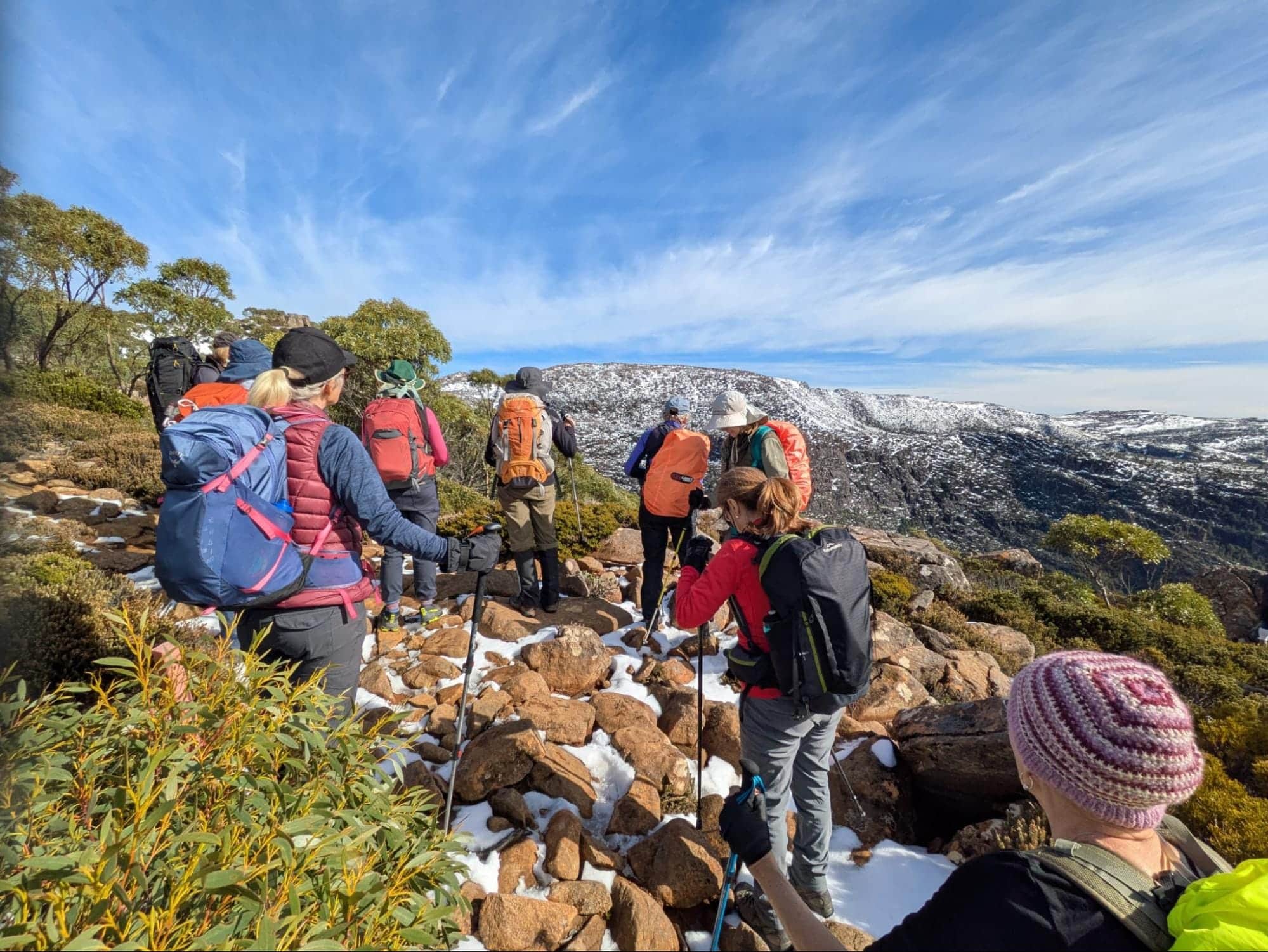
Tasmania is Australia’s best island for a first multi-day walk, and also the one most likely to humble you. There is nothing between the island’s south coast and Antarctica, weather turns in an afternoon, and plenty of the trails that appear on “best of” lists are genuinely unsuitable for a first-timer.
This guide ranks ten multi-day hikes in Tasmania that a reasonably fit beginner can actually complete, from the gentlest coastal wander to the trail worth building towards. Each entry lists the terrain, the daily distances, the grade under the Australian Walking Track Grading System, and whether a fully supported version exists so you can walk it without carrying a full pack.
What makes a multi-day hike beginner-friendly in Tasmania?
A beginner-friendly multi-day hike in Tasmania is one with well-formed tracks, daily distances under about 15 kilometres, modest elevation gain, a short escape route to a road or shelter, and no requirement for off-track navigation. Track grade matters far more than total distance.
The five factors that decide whether a Tasmanian trail suits a first-timer:
- Track surface and grade. Boardwalk, beach and hardened track are forgiving. Boulder fields, root-tangled rainforest and boggy buttongrass plains are slow and tiring in a way that raw kilometres do not capture.
- Daily distance and elevation. Around 10 to 15 kilometres a day with under 400 metres of climbing is a comfortable introduction. The same distance with 900 metres of climbing is a different walk entirely.
- Exposure and escape options. Alpine and exposed coastal sections leave you with nowhere to shelter when the weather changes. Trails that return to a lodge, hut or vehicle each night dramatically lower the risk.
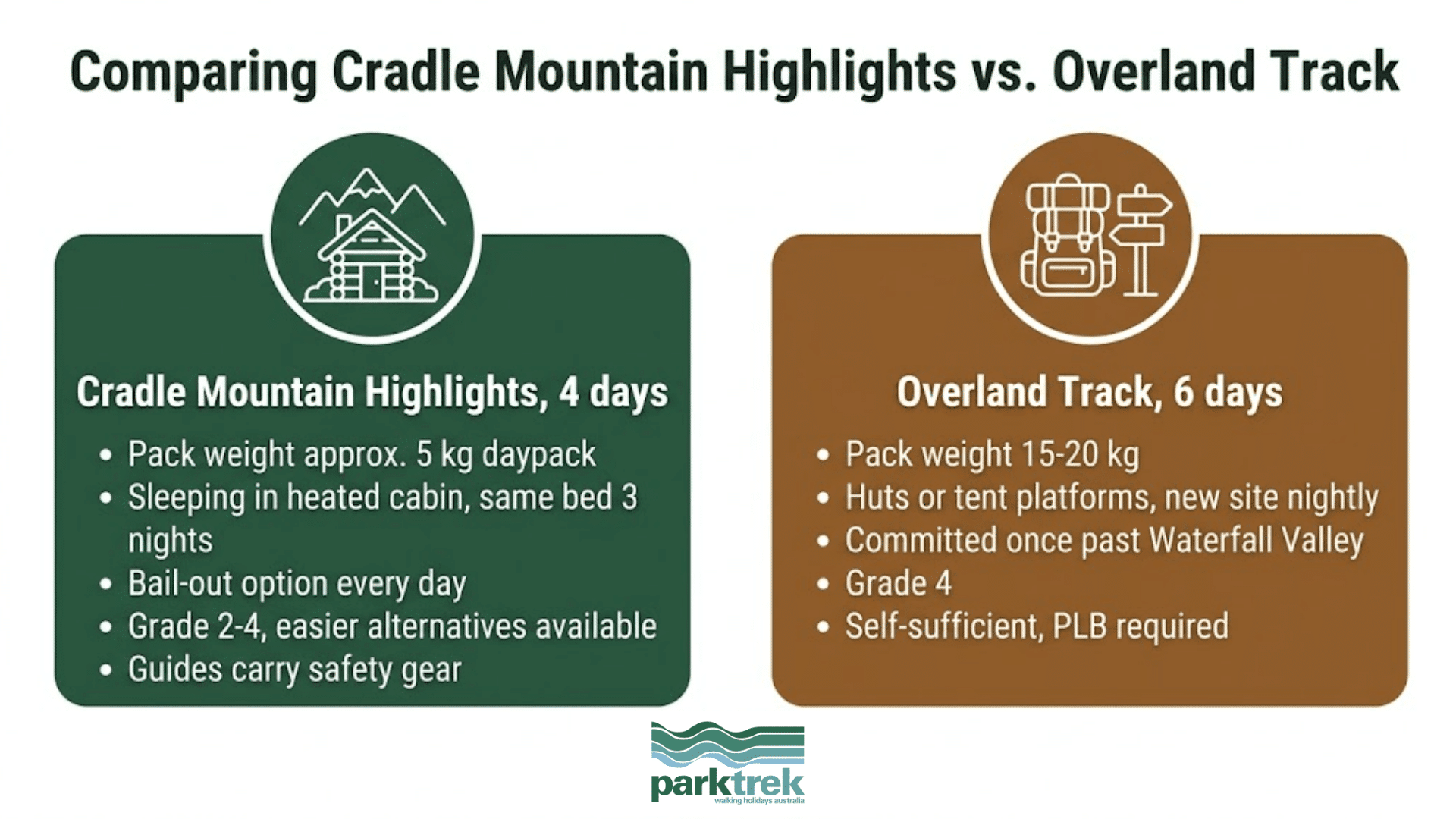
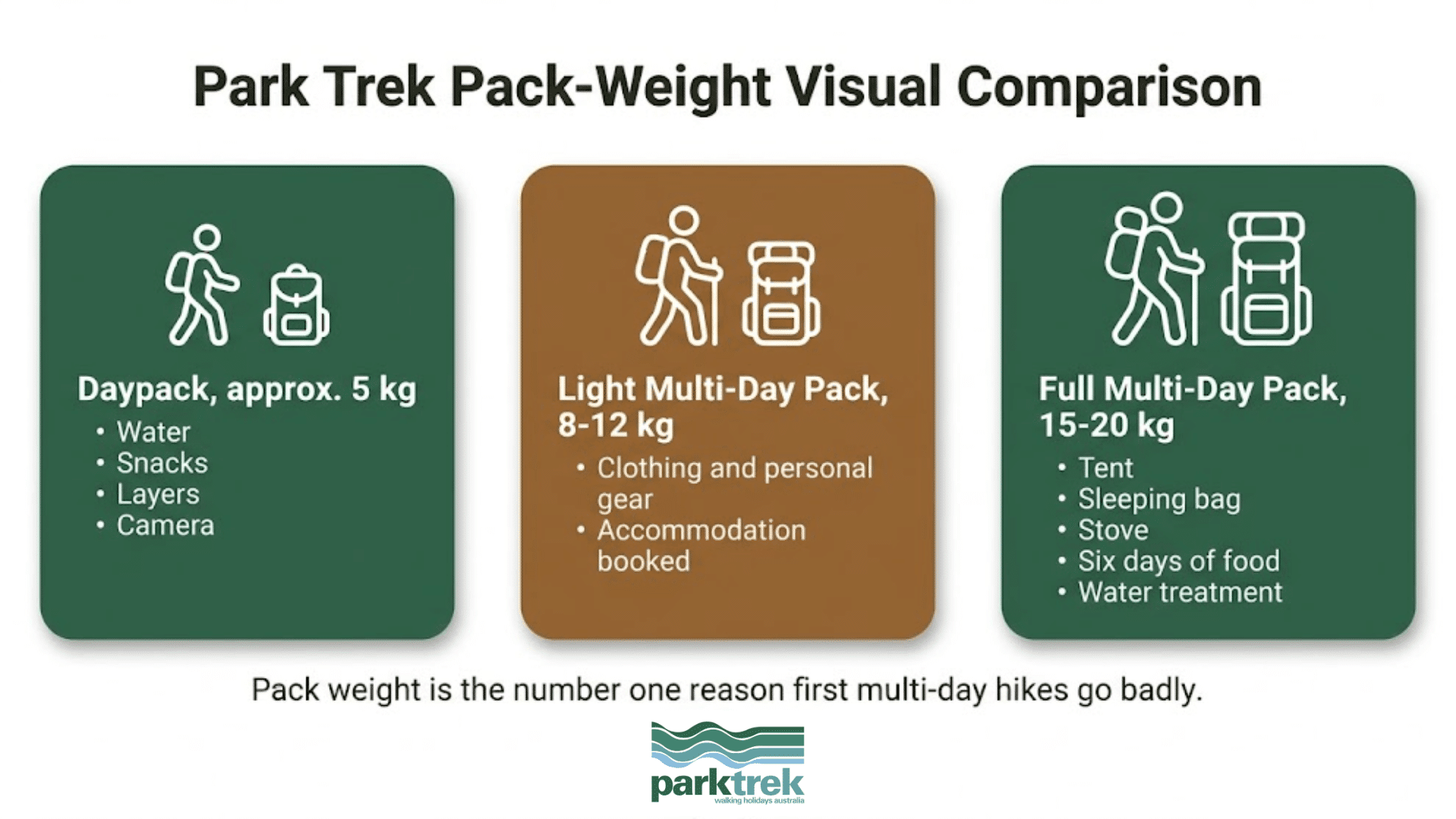
- Pack weight. Carrying a full multi-day pack of 15 to 20 kilograms is the single biggest reason first-timers struggle. Walking the same trail with a five-kilogram daypack turns a hard day into an enjoyable one (what we describe as “pack-free walking” – see below).
- Pack-free walking means you carry only a light daypack with water, snacks, layers and a camera, while your main luggage is transported to your accommodation each day. On Park Trek’s Tasmanian walks, every trail below that we guide is walked pack-free.
The Australian Walking Track Grading System, explained
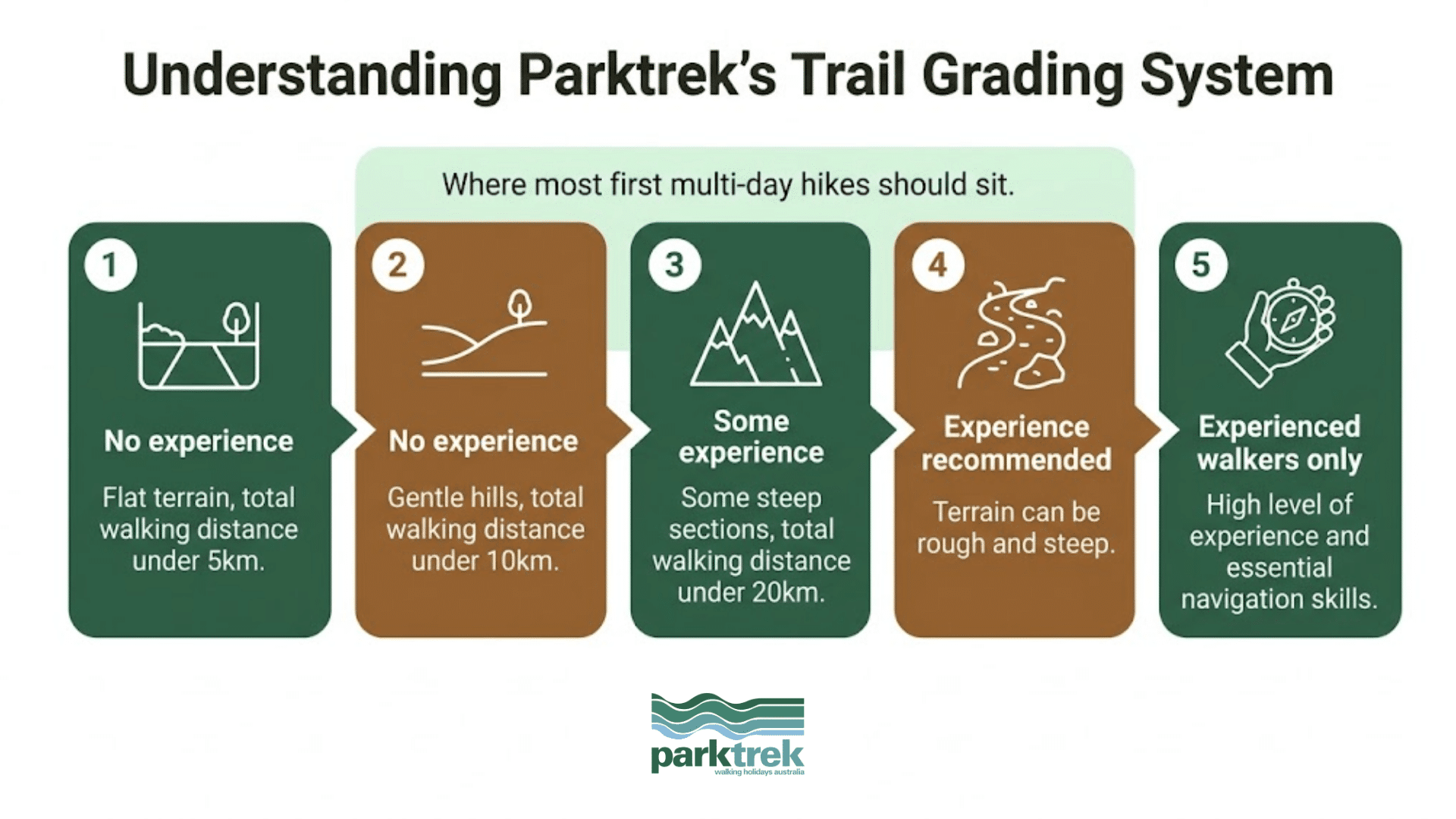
The Australian Walking Track Grading System rates tracks from Grade 1 to Grade 5 based on experience required, gradient, surface quality, signage and length. For a first multi-day hike, Grade 2 and Grade 3 are the sweet spot, with the occasional Grade 4 section if you are walking with guides.
| Grade | Experience required | Typical walking surface | Length guide – walk per day | Suits a beginner? |
|---|---|---|---|---|
| Grade 1 | None | Flat, even, no steps or steep sections | Under 5 km | Yes, though rarely multi-day |
| Grade 2 | None | Hardened or compacted, gentle hills, occasional steps | Under 10 km | Ideal starting point |
| Grade 3 | Some bushwalking experience recommended | Formed track, some steep sections and rough surface | Under 20 km | Yes, with reasonable fitness and preparation |
| Grade 4 | Bushwalking experience recommended | Rough, steep, limited signage | Distance varies | Only with guides or a strong base |
| Grade 5 | Very experienced walkers only | Rough, steep, often unmarked, navigation skills essential | Distance varies | No |
Most quality Tasmanian itineraries publish a grade for every single day, not just an overall rating, which is what you want to look for when comparing options.
Park Trek’s walk grading guide breaks down how each grade translates into a real day on the trail. These details are also included in the detailed Trip Notes available for each of Park Trek’s walks.
The 10 best multi-day hikes in Tasmania for beginners, at a glance
| Rank | Walk | Days | Distance | Grade | Terrain | Guided pack-free option |
|---|---|---|---|---|---|---|
| 1 | Bay of Fires (larapuna) | 3-4 | 47 km | 2-3 | Beach, granite headland, coastal heath | Yes |
| 2 | Bruny Island (lunawanna-alonnah) | 4 | Approx. 10-14 km per day | 2-3 | Beach, cliff top, forest | Yes |
| 3 | Maria Island | 2-4 | 25-49 km | 2-3 | Flat coastal, historic sites | No |
| 4 | Cradle Mountain Highlights | 4 | 33 km | 2-4 | Boardwalk, alpine, glacial lakes | Yes |
| 5 | Three Capes Track (turrakana) | 3-4 | 35 km | 3-4 | Sea cliffs, formed steps | Yes |
| 6 | Southwest & Mount Field | 4 | Varies | 2-4 | Waterfalls, tall forest, alpine | Yes |
| 7 | takayna / Tarkine | 5 | Varies | 2-4 | Rainforest, river, wild coast | Yes |
| 8 | Freycinet Peninsula Circuit | 2-3 | 27 km | 3-4 | Beach, saddle climb, camping | No |
| 9 | Walls of Jerusalem | 2-3 | 34 km | 4 | Steep alpine entry, tarns | No |
| 10 | Overland Track | 6 | 65 km | 4 | Alpine, huts, full pack | No |
1. Bay of Fires (larapuna), North East Coast
Days: 3 or 4 | Distance: 47 km across four days | Grade: 2-3 | Nearest hub: Launceston
The Bay of Fires is the most forgiving multi-day walk in Tasmania and the one we recommend most often to people who have never done one before. Days are spent almost entirely at sea level on white sand and granite, with the region’s orange lichen-covered boulders as a constant backdrop.
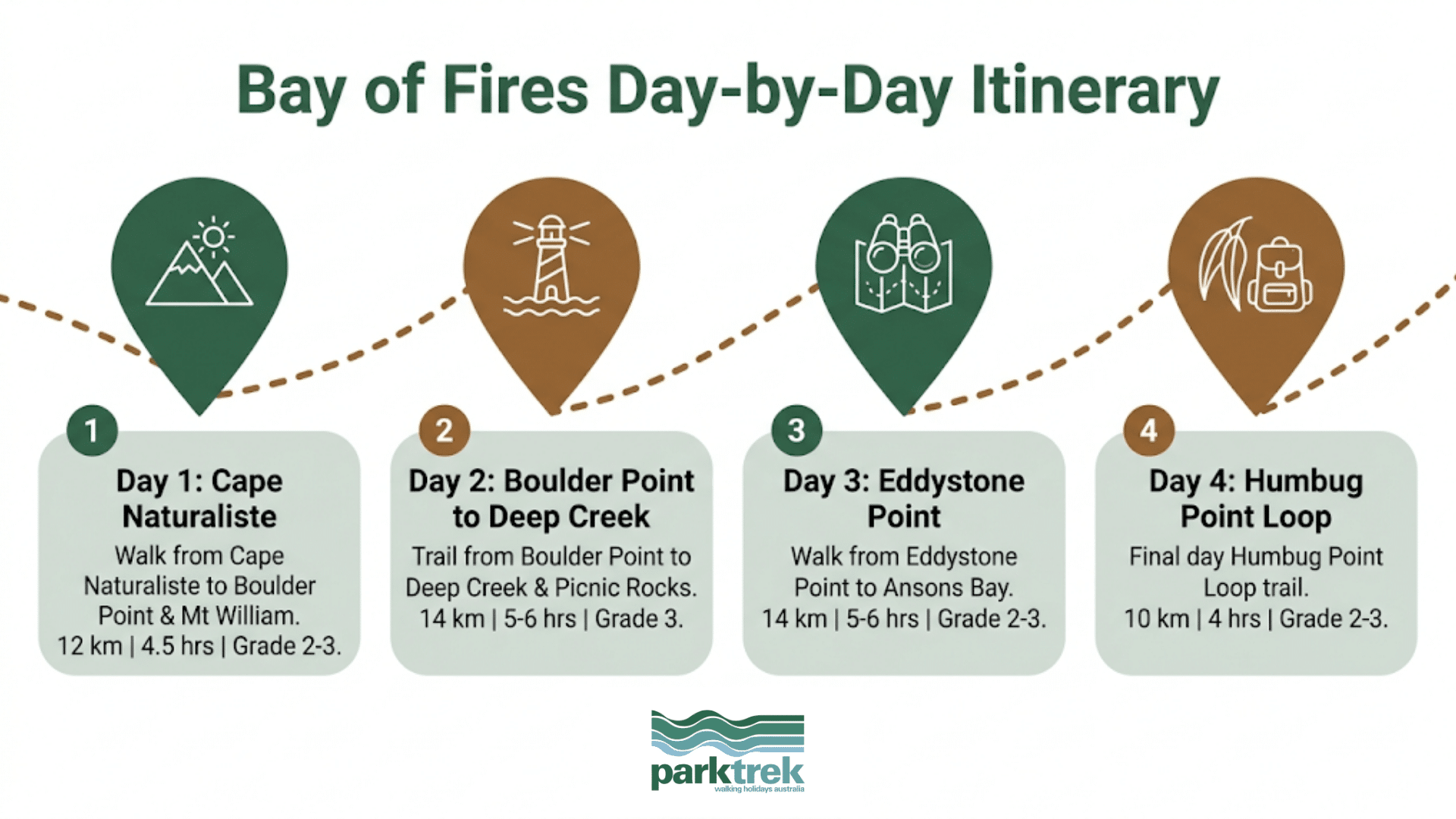
Known to the palawa people as larapuna, the walk moves south through Mount William National Park from Cape Naturaliste, past Boulder Point and Deep Creek, on to the 1889 granite lighthouse at Eddystone Point, and finishes on the Humbug Point loop near St Helens. Daily distances sit between 10 and 14 kilometres across roughly four to six hours of walking, with one short optional climb to the summit of wukalina / Mount William at 216 metres.
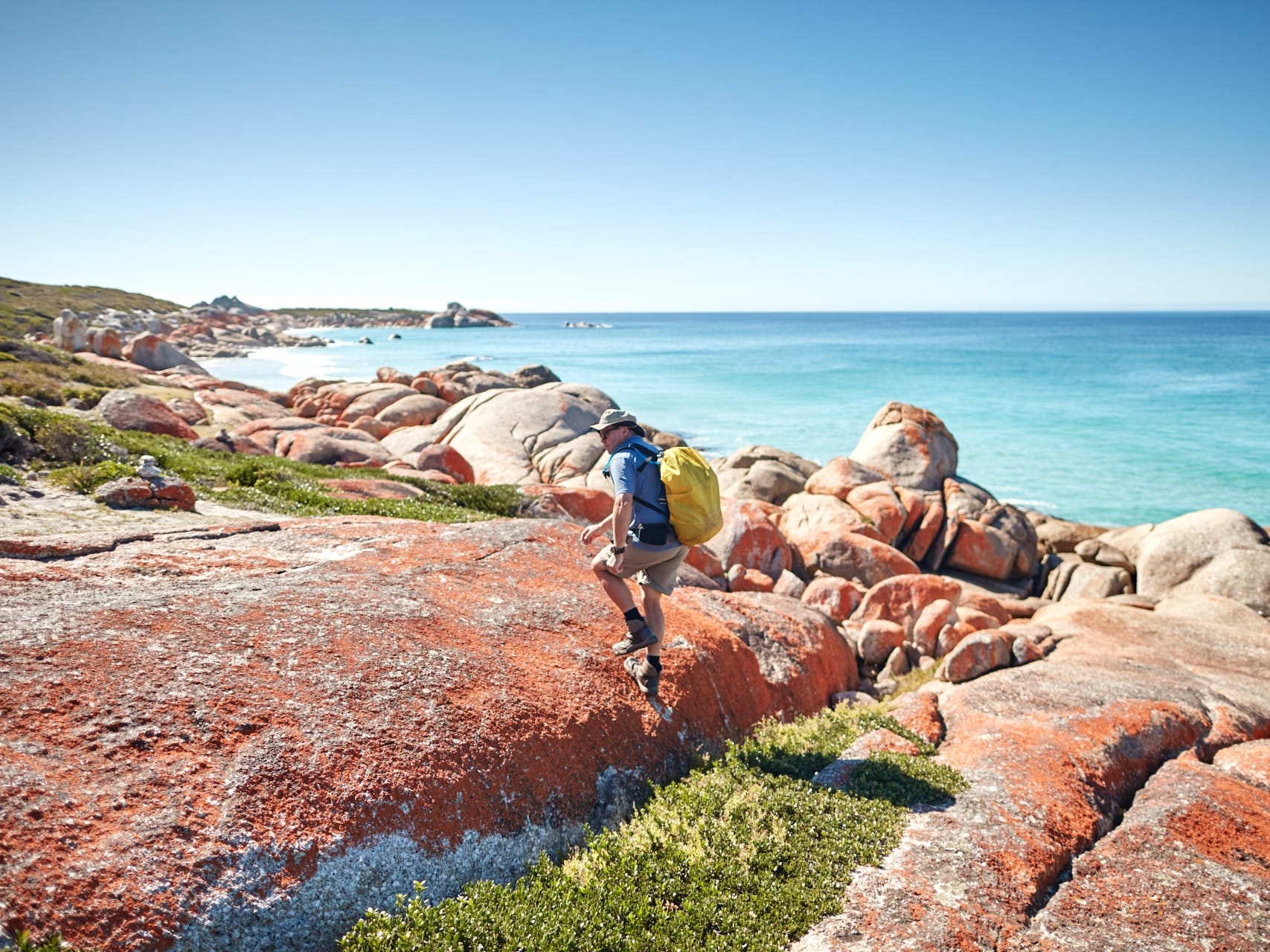
Why it suits beginners: the terrain is flat, the surface is soft sand and firm rock rather than roots and boulders, and there is a swim available most afternoons. The hardest part of the day is usually deciding whether the water is warm enough.
Watch for: soft sand is more tiring than it looks, and there are shallow lagoon crossings at Deep Creek and Ansons Bay depending on water levels.
Park Trek runs this as a 4-day Bay of Fires Walk with all inclusive pricing, staying at Icena Farm. If you want a shorter first taste, the 3-day Bay of Fires Highlights Walk covers the best of the coastline in a long weekend. We can also design a private group women-only yoga and walk retreat on the same coastline.
2. Bruny Island (lunawanna-alonnah), South East
Days: 4 | Distance: roughly 10-14 km per day | Grade: 2-3 | Nearest hub: Hobart
Bruny Island packs an unusual amount of variety into short daily distances, which is exactly what you want on a first multi-day walk. Over four days you cross The Neck, walk the cliff edge at Fluted Cape, take in the pounding surf beaches of Cloudy Bay, visit the historic Cape Bruny Lighthouse, and finish on the tranquil Cape Queen Elizabeth Track.
The optional summit of Mount Mangana, the island’s highest point, gives you a genuine climb without committing to a full alpine day. The Labillardiere Peninsula circuit through open heath is one of the best short birdwatching walks in the state.
Why it suits beginners: the island’s compact geography means every walk is close to a road, so bailing out or shortening a day is straightforward. Days rarely exceed four and a half hours of walking.
Watch for: exposure at Fluted Cape and Cape Bruny. This is a coastline where wind, rather than distance, defines the day.
The 4-day Bruny Island Walk departs Hobart and is walked with a daypack only.
3. Maria Island, East Coast
Days: 2-4 | Distance: 25-49 km depending on route | Grade: 2-3 | Nearest hub: Triabunna
Maria Island is the best self-guided introduction to overnight walking in Tasmania because there are no cars, no shops and no way to get lost on the main routes. A ferry drops you at Darlington, where you can sleep in the old penitentiary bunkrooms or camp, then walk out and back to Frenchs Farm and Encampment Cove over two to four days.
The full Frenchs Farm circuit runs about 49 kilometres over four days and takes in the Bishop and Clerk summit scramble. A gentler version bases you at Darlington and Frenchs Farm with day walks to the Painted Cliffs, the Fossil Cliffs and Haunted Bay.
Why it suits beginners: the island is flat through the middle, wildlife is everywhere, and the penitentiary accommodation means you can walk a multi-day route without carrying a tent.
Watch for: you must carry all your own food and water treatment, and the Bishop and Clerk summit is a genuine rock scramble that is best skipped in wind.
Park Trek does not currently run a guided Maria Island itinerary. If you want a supported walk on a similar stretch of east coast, the Bay of Fires walks are the closest equivalent in feel.
4. Cradle Mountain Highlights, North West
Days: 4 | Distance: 33 km | Grade: 2-4 | Nearest hub: Launceston
Most people assume the only way to experience Cradle Mountain over several days is the Overland Track. It is not, and for a beginner the base-camp approach is much better. You sleep in the same cabin for three nights and walk a different route each day, which means no pack, no tent, and the freedom to swap a hard day for an easy one if the weather turns.
The four days cover the Cradle Valley Boardwalk and Waldheim Chalet, wombat spotting across the Ronny Creek buttongrass plains, the chained ascent of Hansons Peak with the Twisted Lakes on the return, the steep climb to Marion’s Lookout with a descent along a section of the actual Overland Track past Crater Falls, and a final Dove Lake Circuit.
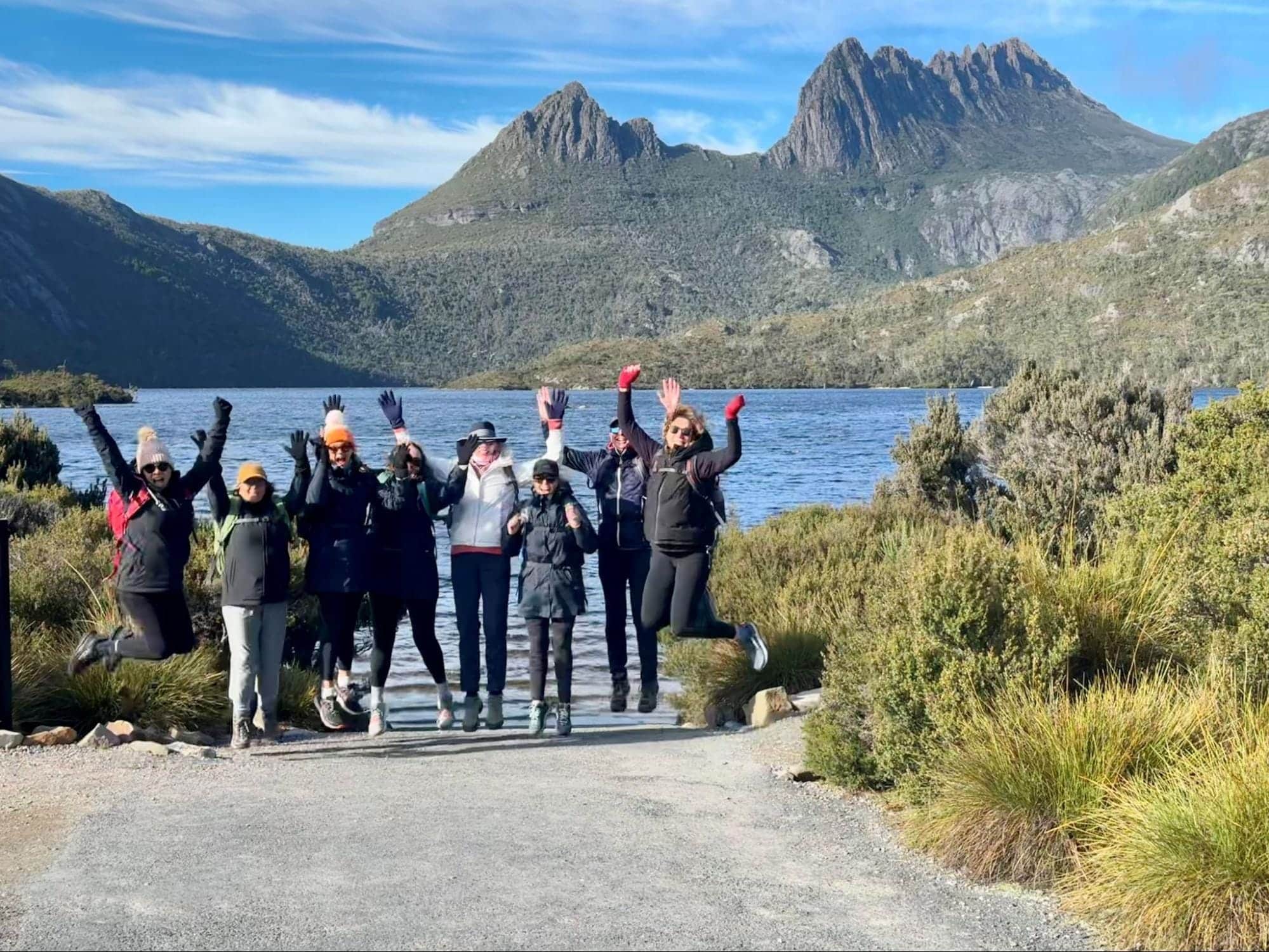
Why it suits beginners: Day 1 and Day 4 are Grade 2. Days 2 and 3 are Grade 3-4 with easier alternatives available. You get the alpine scenery, the fagus in autumn and the Dove Lake boatshed photograph without a six-day commitment.
Watch for: this is a true alpine environment. Snow is possible in any month, and the Hansons Peak chains require a head for heights.
The 4-day Cradle Mountain Highlights Walk runs from A$2,950 per person all inclusive, based at Discovery Parks Cradle Mountain.
5. Three Capes Track (turrakana / Tasman Peninsula), South East
Days: 3 or 4 | Distance: 35 km | Grade: 3-4 | Nearest hub: Hobart
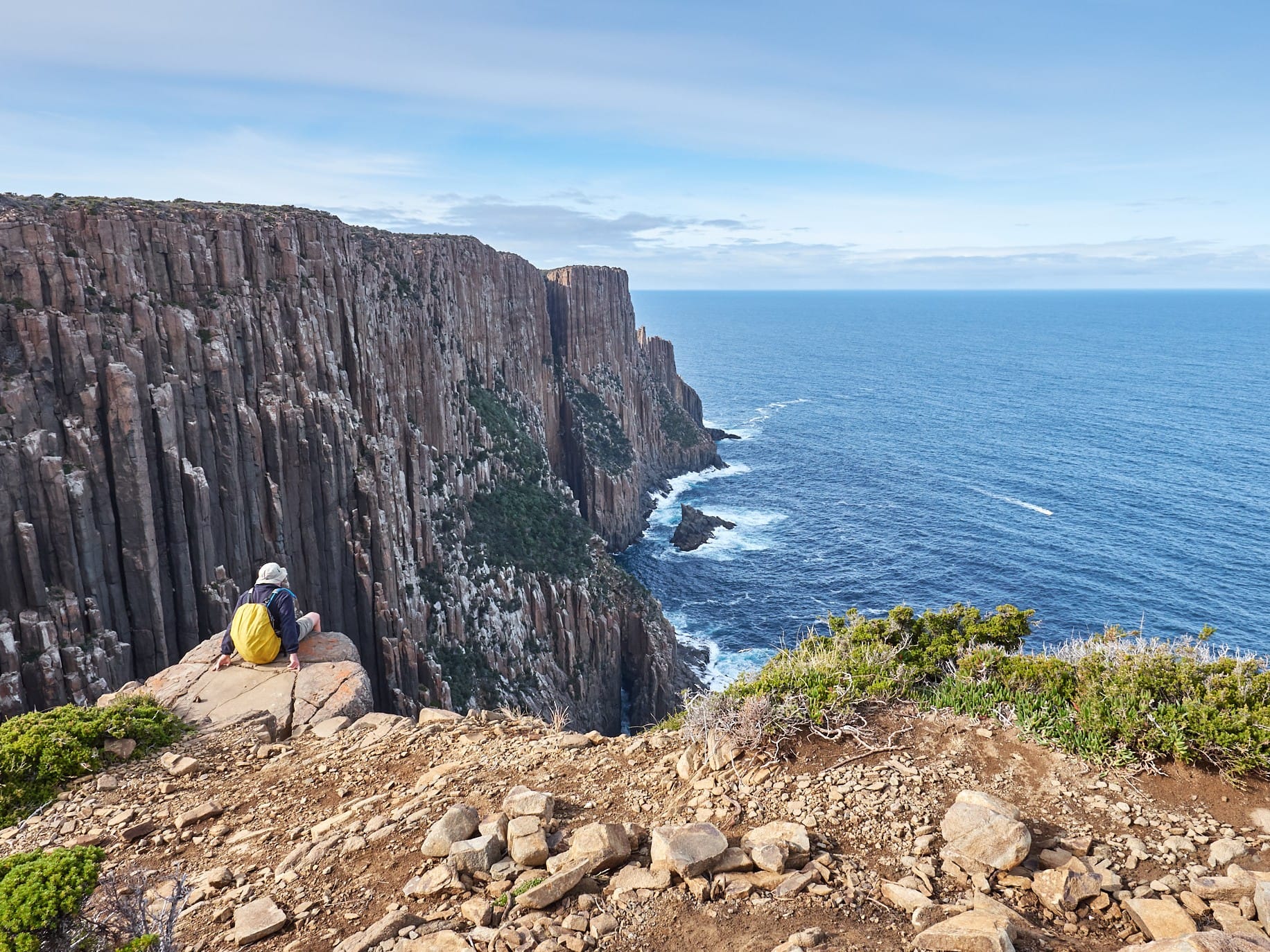
This is the walk most beginners have heard of, and it earns the reputation. The Tasman Peninsula holds the highest sea cliffs in the Southern Hemisphere, and the dolerite columns of the Candlestick and the Totem Pole at Cape Hauy are among the most striking coastal formations in Australia.
A four-day supported itinerary crosses the dunes and heath to Crescent Bay with an optional ascent of Mount Brown, walks out to Cape Raoul across heathland and cliff-top plateau, takes on the constructed stone steps to Cape Hauy, and finishes with a three-hour wilderness cruise beneath Cape Pillar.
Why it suits beginners: individual days are short, between 8 and 14 kilometres, and the tracks are exceptionally well built. There is no navigation involved.
Watch for: Cape Hauy is graded Grade 3-4 for good reason. The stone steps ascend and descend almost the entire length of the trail, and you do them twice. Cape Raoul records some of the strongest winds in Australia.
Park Trek’s 4-day Three Capes Track Walk runs from A$3,095 per person all inclusive and is its own route rather than the government track, staying at Stewart’s Bay Lodge. A 3-day Three Capes Highlights version is available if you are short on leave.
6. Southwest & Mount Field, South
Days: 4 | Distance: varies by day | Grade: 2-4 | Nearest hub: Hobart
Mount Field is the oldest national park in Tasmania and the most underrated on this list. In a single day you can move from Russell Falls through some of the tallest flowering trees on earth into alpine moorland, which is a range of environments that most Australian parks cannot offer at all, let alone within a few kilometres.
Paired with the edge of the Southwest wilderness, this itinerary gives beginners a genuine sense of remoteness without the commitment or risk of a Southwest thru-hike.
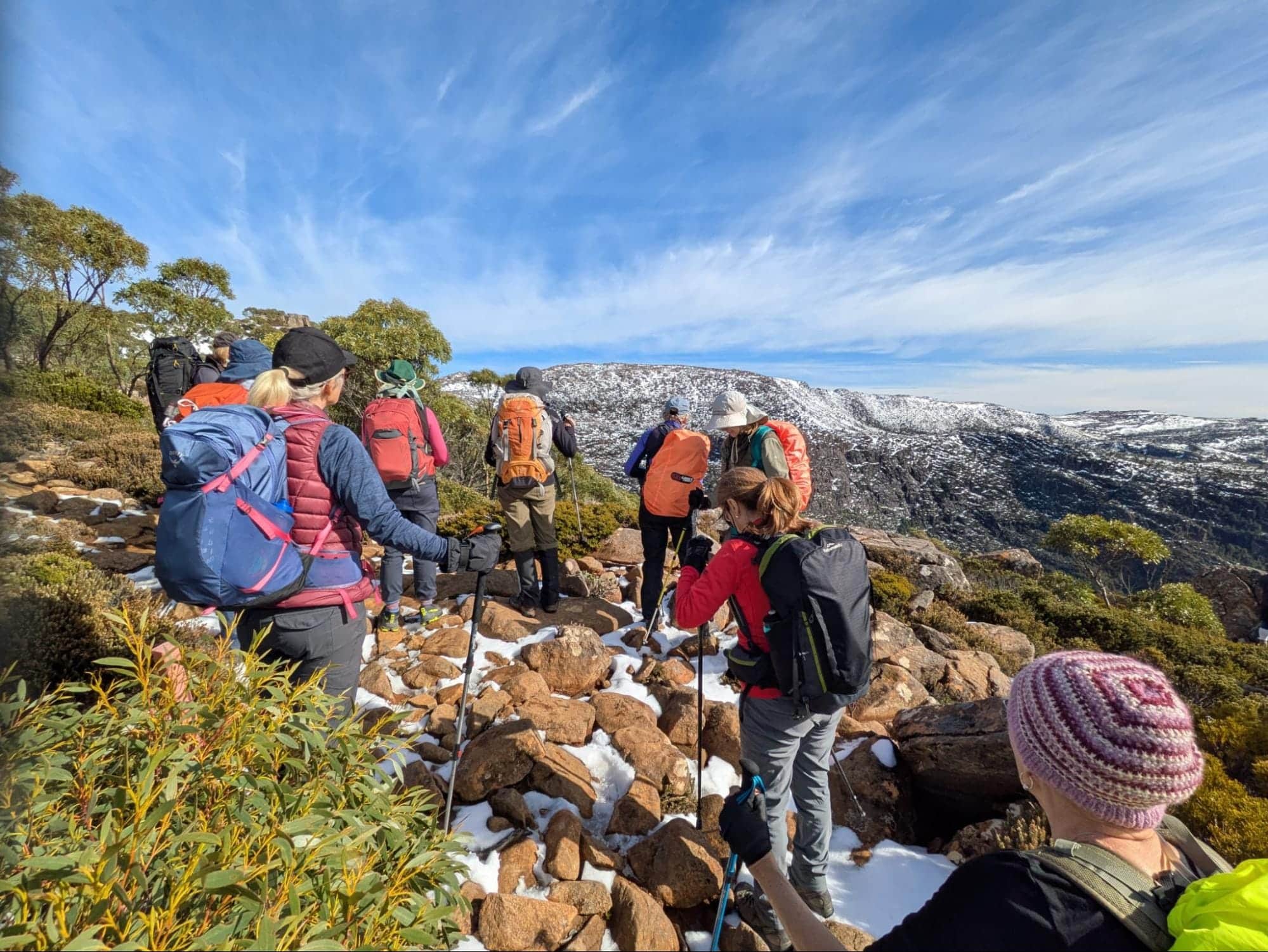
Why it suits beginners: the tall forest and waterfall walks are Grade 2 and short, so the harder alpine days sit alongside genuinely easy ones rather than back to back.
Watch for: the alpine sections at Mount Field are properly exposed and this park receives significant snowfall.
See the 4-day Southwest & Mount Field Walk for current daily grades and departures.
7. takayna / Tarkine, North West
Days: 5 | Distance: varies by day | Grade: 2-4 | Nearest hub: Launceston or Devonport
takayna, the Tarkine, is the largest tract of cool temperate rainforest in the Southern Hemisphere outside South America. Walking through it feels genuinely ancient in a way that photographs do not convey. The five-day route moves between rainforest, the Pieman River, mountain country and an extraordinarily wild stretch of west coast.
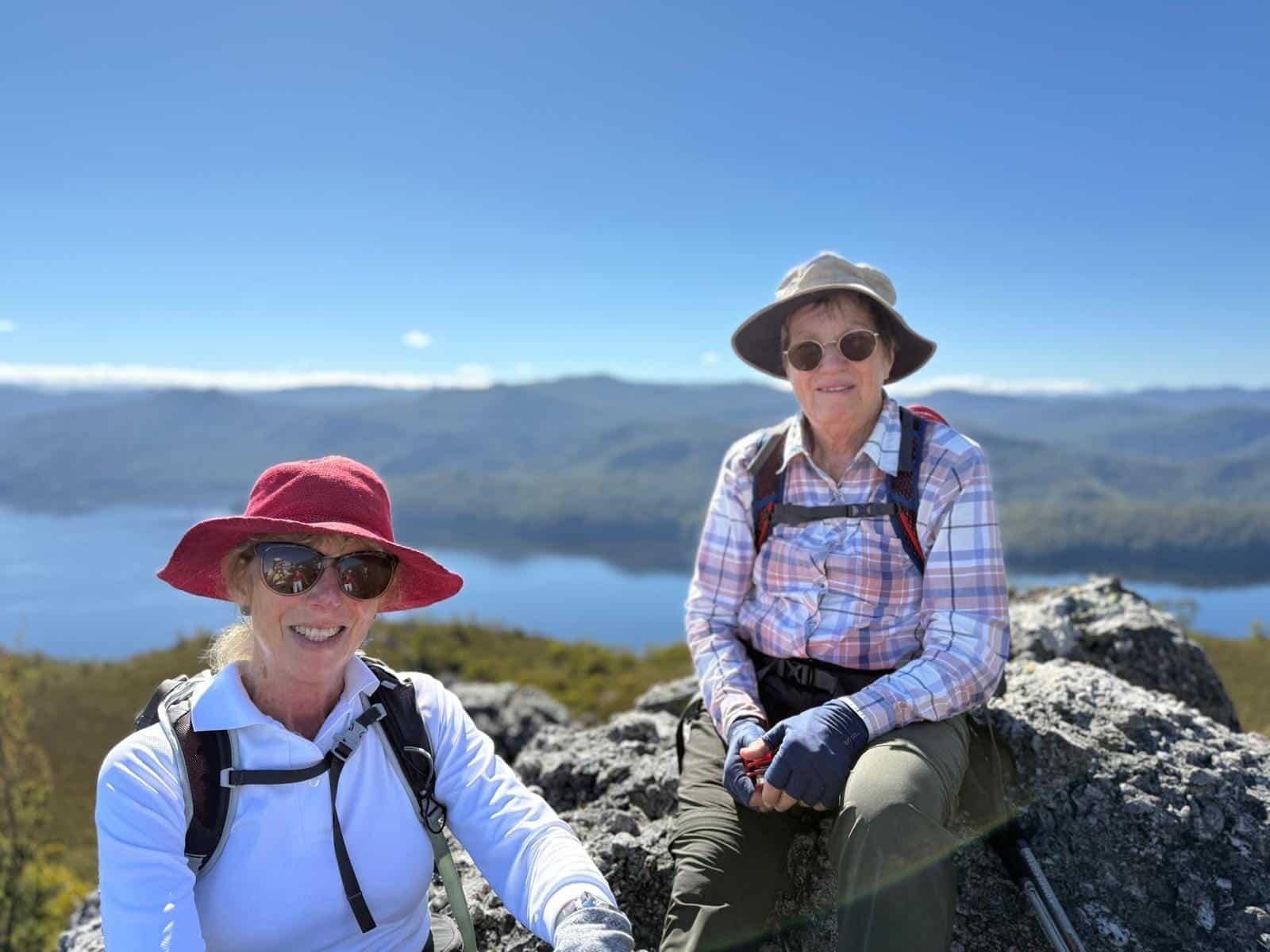
Why it suits beginners: the rainforest walking is soft underfoot and mostly flat, and the region is far less trafficked than the east coast. The extra day compared with the standard four-day format also means a gentler daily pace.
Watch for: rainforest walking is wet almost by definition. Waterproof boots and a genuinely waterproof jacket matter more here than anywhere else on this list.
Park Trek runs the 5-day Tarkine Wilderness Walk, plus a special-departure Tarkine and Cradle Mountain combination that pairs rainforest with alpine country.
8. Freycinet Peninsula Circuit, East Coast
Days: 2-3 | Distance: 27 km circuit | Grade: 3-4 | Nearest hub: Coles Bay
The Freycinet Peninsula Circuit is the classic self-guided Tasmanian starter route, and it is beautiful, but it is a step up from the walks above rather than an entry point. You carry your own pack, camp at Cooks Beach or Wineglass Bay, and manage your own water.
Walk it anti-clockwise from the car park to limit the spread of Phytophthora root rot. The reward is beachfront campsites and, on the final day, the Wineglass Bay saddle.
Why it suits beginners: short daily distances, an obvious route, and civilisation an hour away at Coles Bay.
Watch for: you are carrying a full pack, water is limited on the peninsula, and the possums at the campsites are professionals when it comes to opening food bags.
9. Walls of Jerusalem, Central Highlands
Days: 2-3 | Distance: 34 km circuit | Grade: 4 | Nearest hub: Launceston or Deloraine
The Walls of Jerusalem is the only Tasmanian national park with no road access, and the first sight of the dolerite peaks reflected in the tarns is one of the great moments in Australian bushwalking. It appears on beginner lists mainly because you can base yourself at Wild Dog Creek and do day walks from there rather than moving camp each night.
Be honest with yourself about the entry, though. The climb into the park is steep and sustained with a full pack, and once you are up there you are in exposed alpine country carrying everything you need.
Why it might suit a confident beginner: the base-camp structure removes the hardest part of multi-day walking, which is packing up and re-packing every morning.
Watch for: Grade 4 throughout, no road access, and alpine weather. Treat this as your second or third multi-day walk, not your first.
10. Overland Track, Cradle Mountain to Lake St Clair
Days: 6 | Distance: 65 km one way | Grade: 4 | Nearest hub: Launceston
The Overland Track is on this list because it is the walk almost every Tasmanian beginner has in mind, and because it deserves an honest answer rather than a place at number one. It is Australia’s premier alpine walk, with huts and tent platforms every night, a well-defined southbound route between October and May, and side trips to Barn Bluff, Mount Oakleigh and Mount Ossa.
It is also six days, 65 kilometres, largely above 1,000 metres, carrying 15 to 20 kilograms, in country where blizzards occur in summer. Walkers are regularly evacuated. Calling it a beginner hike is how people end up in trouble.
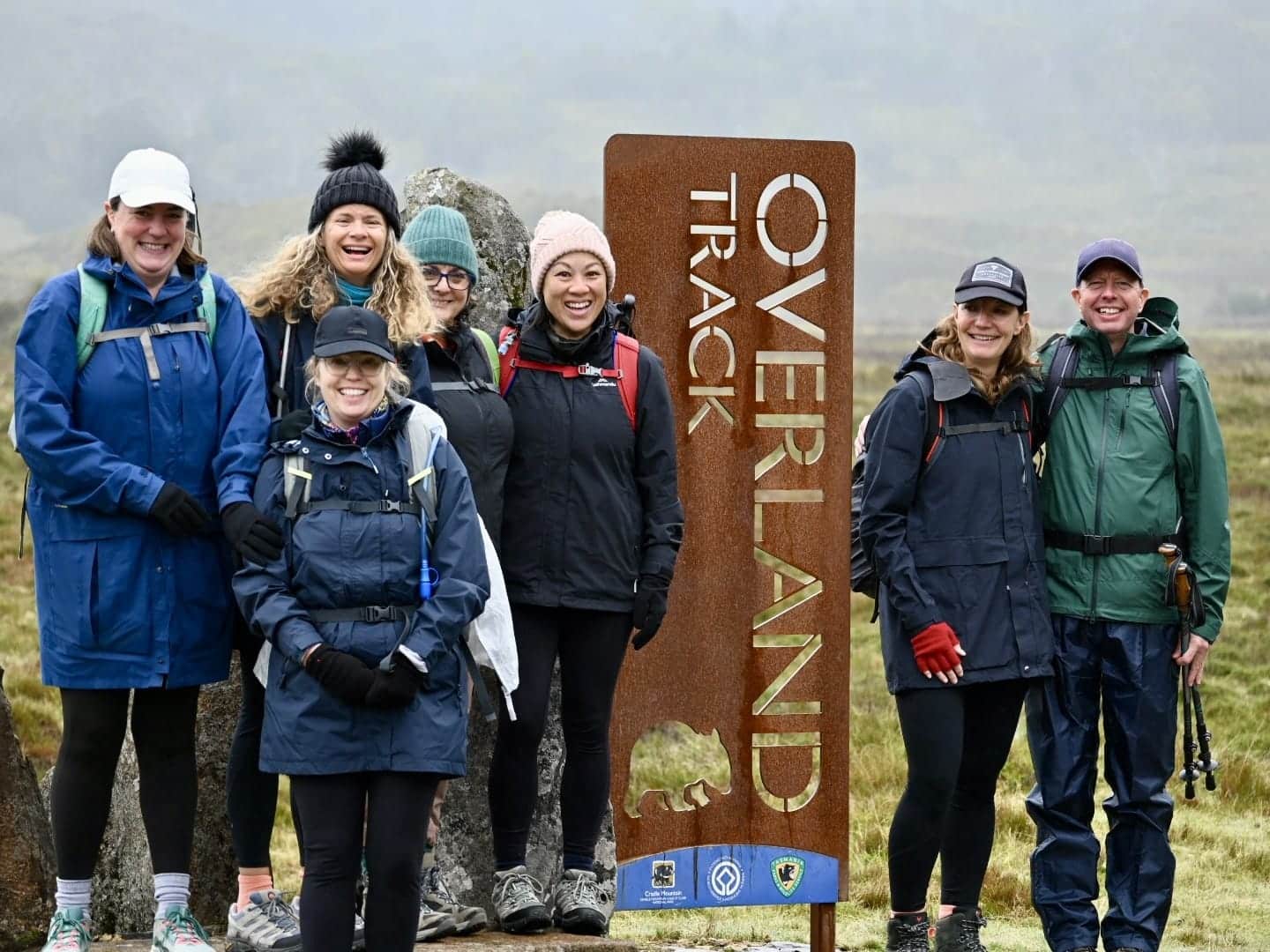
Treat it as your goal, not your starting line. Do two or three of the supported walks above first, learn how your body handles consecutive walking days, then book the Overland with the confidence that you can manage a bad-weather day at altitude.
If you want the Cradle Mountain landscape without the full commitment, the 4-day Cradle Mountain Highlights Walk walks a section of the Overland Track itself, near Crater Lake.
Which of these should you actually start with?
If this is your first multi-day walk and you want the highest chance of loving it, start with the Bay of Fires. It has the gentlest terrain, the shortest days, and a swim at the end of most of them.
Use this as a quick decision guide:
- Never walked consecutive days before: Bay of Fires, 3 or 4 days.
- Reasonably fit, want variety over distance: Bruny Island, 4 days.
- Want alpine scenery without an alpine commitment: Cradle Mountain Highlights, 4 days.
- Want the famous coastline and don’t mind stairs: Three Capes Track, 3 or 4 days.
- Want to feel genuinely remote: takayna / Tarkine, 5 days, or Southwest & Mount Field, 4 days.
- Confident, carrying your own pack, self-guided: Maria Island, then Freycinet.
- Building towards something bigger: Walls of Jerusalem, then the Overland Track.
For a first multi-day hike in Tasmania, a guided pack-free walk removes the three things that most commonly go wrong for beginners: pack weight, weather judgement and logistics. Self-guided walking is cheaper and more flexible, but you are absorbing all of that risk yourself.
Guided, self-guided or pack-free: which is right for a first multi-day hike?
Not sure where you sit? Park Trek’s find your perfect walk quiz matches you to a grade and a destination in a couple of minutes.
| Key factor to consider | Self-guided, carrying a pack | Self-guided with transfers | Guided pack-free |
|---|---|---|---|
| Pack weight | 15-20 kg | 8-12 kg | Approx. 5 kg daypack |
| Accommodation | Tent or hut, you book it | Lodges, you book it | Lodges, arranged for you |
| Meals | Carried and cooked by you | Mixed | All meals, snacks and drinks provided |
| Navigation | Your responsibility | Your responsibility | Two accredited guides, front and rear |
| Weather decisions | Your responsibility | Your responsibility | Guides adjust the route on the day |
| National park fees | You arrange | You arrange | Included |
| Typical cost | Lowest | Middle | Highest, but nothing else to pay |
| Best for | Experienced walkers | Confident walkers with good gear | First-timers, solo travellers, anyone short on planning time |
The practical difference on a bad-weather day is significant. A guided group can swap Hansons Peak for a sheltered valley walk and still have a good day. A self-guided pair on the same ridge has to make that call with far less local knowledge.
Park Trek walks all of the Tasmanian trails above pack-free, with a maximum of ten guests and two accredited guides, and the price includes accommodation, all meals, transfers and national park entry. See why walk with us for the full inclusion list, or read the ultimate guide to pack-free walking holidays in Australia.
When is the best time to hike in Tasmania?
The Tasmanian walking season runs from October to early May, with December through March offering the longest days and most settled conditions. Outside that window, alpine trails carry snow and daylight drops below what most itineraries need.
| Period | Conditions | Best suited to |
|---|---|---|
| October to November | Wildflowers and orchids on the coastal heath, cool days, fewer walkers | Bay of Fires, Bruny Island, Three Capes |
| December to February | Longest daylight, warmest water, peak season | All trails, including alpine |
| March to early April | Settled autumn weather, quieter tracks | Three Capes, Bay of Fires, Cradle Mountain |
| Late April to early May | Fagus turning gold at Cradle Mountain, cold mornings | Cradle Mountain, coastal walks |
| June to September | Snow at altitude, short days, alpine trails for experts only | Off-season coastal walks only |
Two things to know regardless of month. First, Tasmanian weather does not follow the calendar, and snow at Cradle Mountain in January is unremarkable. Second, the fagus, Australia’s only native deciduous tree, turns in late April and is worth planning a trip around.
Park Trek publishes departures by month so you can work backwards from when you can actually take leave, and lists upcoming departures if your dates are flexible.
How fit do you need to be, and how do you train?
You need to be able to walk 12 to 15 kilometres over hilly ground, carrying a light daypack, on consecutive days. That is a realistic target for most reasonably active adults with about twelve weeks of preparation.
The training that matters is specific, not general. Gym cardio helps your engine, but it does not prepare your feet, ankles and knees for six hours on uneven ground.
1. Weeks 1 to 4: build the habit. Two or three walks a week of 60 to 90 minutes on any terrain, in the boots you will actually wear.
2. Weeks 5 to 8: add hills and load. One longer weekend walk of 10 to 12 kilometres with genuine elevation, carrying a daypack loaded to about five kilograms.
3. Weeks 9 to 11: walk back-to-back days. This is the step almost everyone skips and the one that matters most. Walk on Saturday, then walk again on Sunday. Consecutive days are what a multi-day hike actually asks of you.
4. Week 12: taper. Shorter walks, no new gear, and let your legs recover.
Two additional points worth building into your preparation:
- Descents cause more trouble than climbs. Sore knees on day three almost always come from downhill sections, not uphill ones. Practise going down, and consider walking poles.
- Test everything. Boots, socks, jacket, daypack and any anti-chafe products should all have at least one long walk behind them before you leave home.
Park Trek’s guide to training for a multi-day hike sets out a full programme, and the preparation and what-to-wear guide covers the gear side.
What do you actually carry?
On a pack-free walk you carry a daypack of roughly five kilograms. On a self-guided walk you carry everything.
Daypack essentials on a supported walk:
- Two litres of water
- Waterproof jacket and warm layer, regardless of the forecast
- Sun protection, including a hat, in every month
- Personal first aid items and any medication
- Camera or phone, plus a dry bag.
Additional items on a self-guided walk:
- Tent, sleeping bag rated for alpine conditions, and mat
- Stove, fuel and all food for the trip
- Water treatment
- Personal locator beacon or satellite communicator
- Map, compass and the skills to use them
- A completed overnight walker registration
The single most important item on any Tasmanian trail is a genuinely waterproof jacket. Water-resistant is not waterproof, and the difference becomes obvious about ninety minutes into a Tarkine downpour.
How much does a multi-day hike in Tasmania cost?
A guided, all-inclusive multi-day walk in Tasmania costs roughly A$2,850 to A$3,100 per person for a four-day itinerary at the time of writing. Self-guided walks cost far less in fees but require a significant gear investment.
| Cost item | Self-guided | Guided all-inclusive |
|---|---|---|
| National park entry | You pay | Included |
| Accommodation | Camping fees, or hut bookings | Included, 3 nights lodge or cabin |
| All meals and snacks | You buy and carry | Included |
| Transfers and transport | Hire car or shuttle | Included, return from Hobart or Launceston |
| Guides | None | Two accredited guides |
| Gear | A$1,000 to A$2,500 up front | Boots, jacket and daypack only |
| Indicative total, 4 days | A$300 to A$600, plus gear | From A$2,850 |
The gear figure is the one people underestimate. A tent, sleeping bag rated for Tasmanian alpine conditions, mat, stove and pack adds up quickly, and it is a poor investment if you are not yet sure multi-day walking is for you. Walking your first trip supported, then buying gear once you know you love it, is usually the better order.
Park Trek offers up to 10 per cent off for groups and early bookings, and runs private group departures and women’s walks on the same Tasmanian itineraries.
Staying safe on your first Tasmanian multi-day walk
Tasmania has recorded multiple walker deaths and serious accidents in recent years, and the common thread is almost always underestimating the weather, the terrain or the remoteness rather than a lack of fitness.
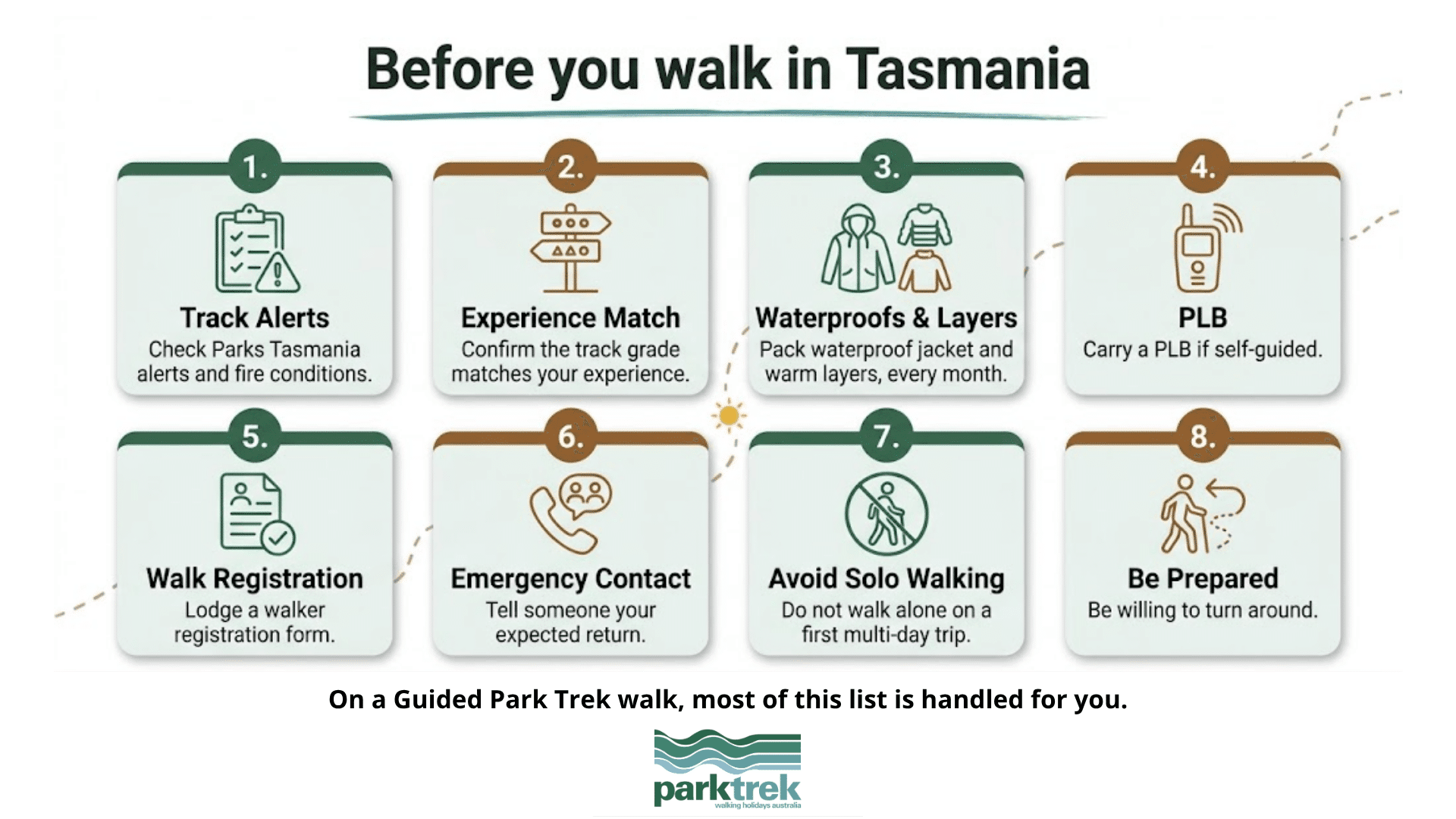
Before any multi-day walk in Tasmania:
- Check track status and alerts with Parks & Wildlife Service Tasmania, including fire conditions
- Match the trail to your actual experience, using the published grade rather than the photographs
- Pack wet weather gear and warm layers even in February
- Carry a personal locator beacon on any self-guided route
- Lodge a walker registration form and tell someone when to expect you
- Do not walk alone on your first multi-day trip
- Turn around if conditions deteriorate, without treating it as a failure
On a guided walk, most of this is handled for you. Two accredited guides walk front and rear so nobody is left behind, they carry safety equipment and communications, and they adjust the route on the day based on conditions. That is the practical value of walking with a company for your first trip.
Hikes to leave for later
Several Tasmanian trails appear on general “best hikes” lists and should not be on a beginner’s shortlist at all:
- South Coast Track, 6 to 9 days, 85 km. Two mountain range crossings, a flight into Melaleuca, and long stretches of remote coast.
- Western Arthurs Traverse, 7 to 9 days, 83 km. Around 250 rainy days a year, quartzite scrambling and scree descents.
- Eastern Arthurs Traverse, 5 to 7 days, 65 km. Borderline mountaineering, with many walkers carrying rope for pack hauling.
- Frenchmans Cap, 3 days, 54 km return. A genuine wilderness route with a demanding scramble to the summit.
- Mount Anne circuit, 4 to 5 days. The Notch is impassable in poor weather and turning back is common.
These are outstanding walks. They are also the reason the grading system exists.
Frequently asked questions
Ready to walk your first multi-day trail in Tasmania?
Tasmania rewards walkers who match the trail to their experience, and punishes those who do not. Starting on the right grade, with the right support, is what turns a first multi-day hike into the first of many.
Park Trek has been running small-group, pack-free guided walking holidays across Australia for more than 25 years, with eight itineraries across Tasmania graded from easy coastal walking to alpine country. Every walk includes quality accommodation, all meals, transfers, national park fees and two accredited guides, with a maximum of ten guests.
- Browse all Tasmania walking tours
- Take the find your perfect walk quiz to match yourself to a grade
- Check departures by month around your leave
- Talk to the team on 1300 775 875 about which walk suits your fitness
Park Trek acknowledges the palawa people as the Traditional Custodians of lutruwita / Tasmania, and pays respect to Elders past, present and emerging.