How Strong is Your Team?
“Who would you want to go to war with – who would be in your team?”
It is an expression I have heard many times over the years – in the context of teams, trust, and team building.
Obviously, it is rarely meant literally. Rather, it is a way of asking a much deeper question: who would you want by your side when things become difficult?
Who would you trust when circumstances are not ideal, plans change, people are tired, and pressure begins to build? We have all seen the way pressure can affect people – for better or for worse. It can be a powerful and important insight.
Most of us spend a lot of time working alongside colleagues, peers and teams, but I wonder how well we really know one another. We see each other in meetings, on video calls and around boardroom tables. We see people at their professional best. What we don’t often get to see is how they respond when faced with discomfort, uncertainty, or genuine challenge.
Walking and Team Building
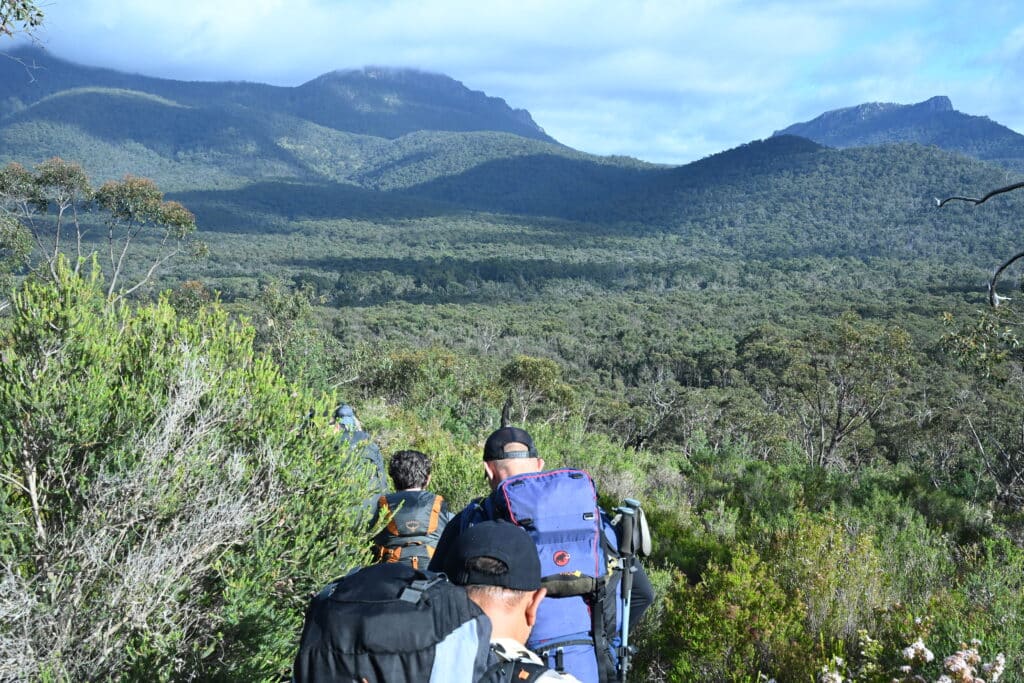
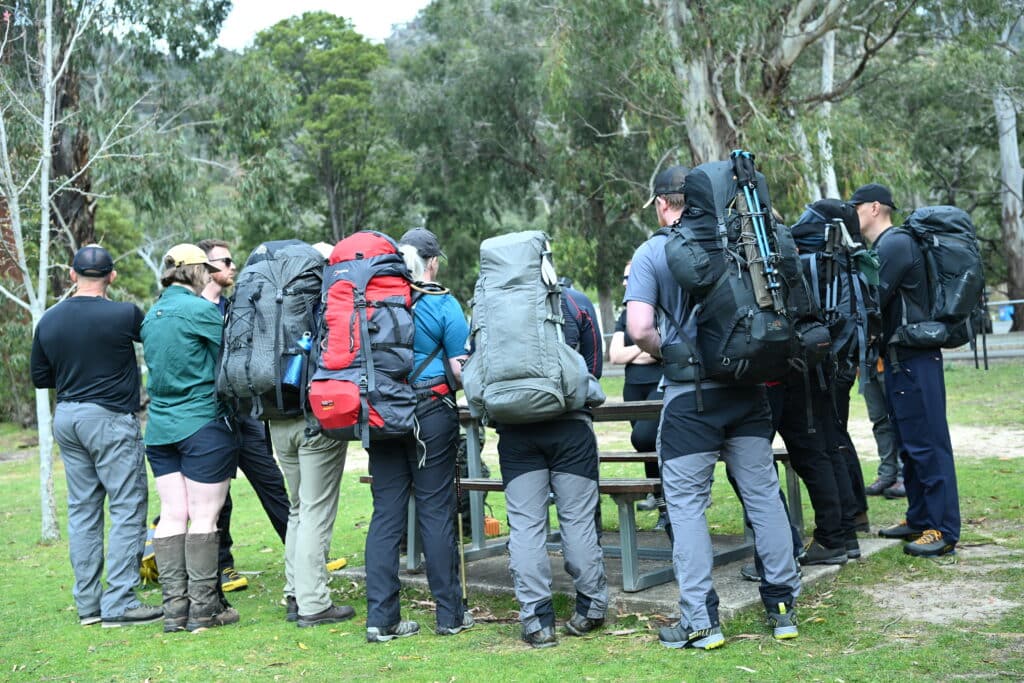
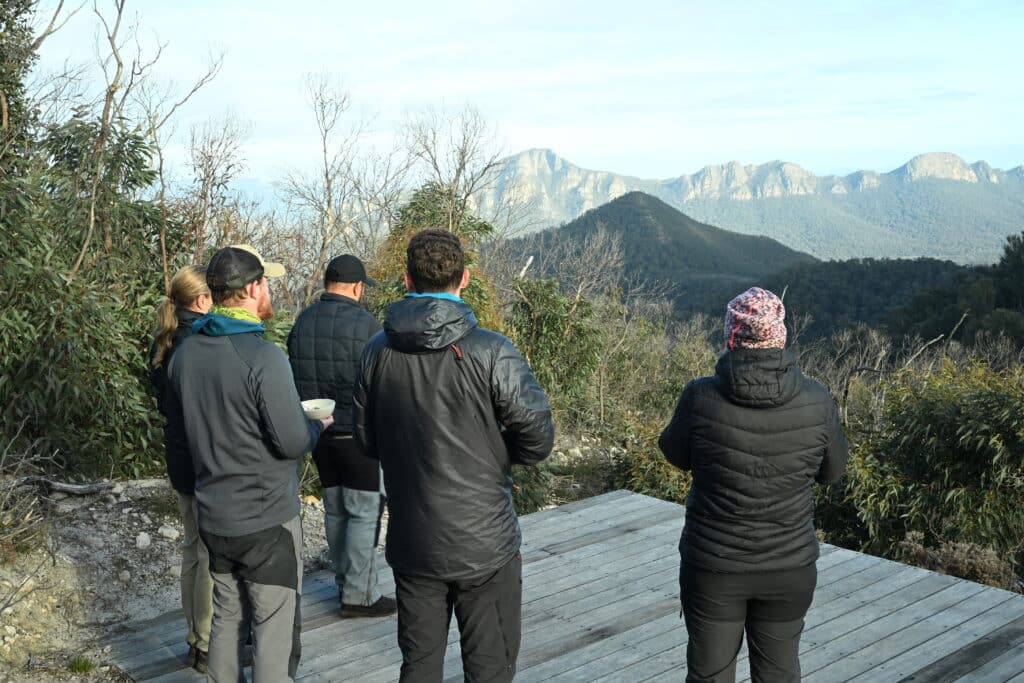
I was reminded of this recently while leading a group of 15 professionals from the United Kingdom on a five-day, four-night walking expedition through Gariwerd – the Grampians. It was designed to be a challenging walk – much more so than our usual public walks.
Like many groups we host, they arrived with varying levels of fitness, different personalities, diverse backgrounds and different expectations. Some knew each other well, others barely at all. Some were highly attuned to the wild, others much less so. Over the course of five days, however, they shared not only some magnificent scenery but also a level of challenge that few modern workplaces can replicate.
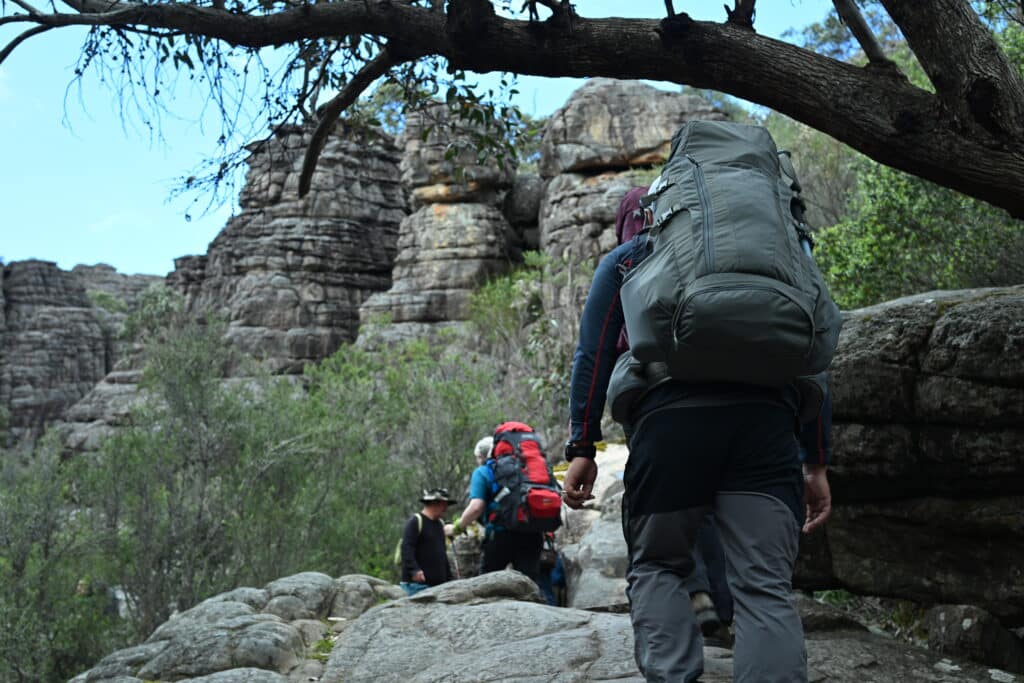
The Grampians have a wonderful way of stripping things back to what matters. Out there, nobody is particularly interested in job titles or organisational hierarchies. The trail does not care whether you’re wilderness expert or the newest member of the team. The climbs are steep for everyone. The weather is the weather. Tired legs affect everybody eventually.
And that’s where interesting things begin to happen.
Over the course of the walk, I watched people reveal parts of themselves that certainly don’t emerge in a weekly team meeting. I watched stronger walkers slow down to support those finding it difficult. I saw quiet individuals become natural leaders. I saw people help one another through challenging moments and celebrate one another’s successes.
What struck me most was how quickly barriers disappeared. The trail was a leveller. What mattered most was how individuals worked as a team and helped others. By the second or third day, conversations had become more genuine. There was more laughter, more honesty and real camaraderie. The shared experience of tackling something challenging together accelerated relationships – including with guides – in a way that I rarely see elsewhere.
Walking for Team and Organisational Resilience
As we covered kilometre after kilometre, I found myself reflecting on how little opportunity most organisations must observe their people outside the familiar environment of work.
Many leadership teams spend years together making important decisions. They manage budgets, solve problems, and navigate change. Yet relatively few, in my experience, ever undertake meaningful adversity together. As a result, they do not always get the chance to see how their colleagues behave when circumstances become uncomfortable.
During the walk, I asked our client about the purpose behind their adventurous training and professional development programme. Their answer was both simple and powerful:
“To provide controlled exposure to risk to build operational effectiveness and resilience.”
The more I thought about it, the more I realised this philosophy extends far beyond military or adventurous training environments. It extends to all organisations.
After all, every organisation wants to be more resilient. Every organisation wants high-performing teams. Every organisation wants people who can adapt, communicate effectively, support one another, and make good decisions under pressure.
But those capabilities are rarely developed by talking about them. They are developed by experiencing them. That’s where controlled exposure to challenge becomes so valuable. It’s real and the results are undeniable, not theoretical.
A multi-day walk through the Grampians is not dangerous, but it is demanding. People become tired. Conditions change. Plans occasionally need to adapt. Individuals must work together, support one another, and remain focused on a common objective.
In short, it provides a safe environment in which people can experience uncertainty, discomfort and challenge while developing confidence, trust and resilience as a team.
The more time I spend with or leading our groups, the more I realise that walking expeditions offer something many traditional team-building activities struggle to deliver: authenticity.
There is no script. No PowerPoint presentation. No facilitator standing at the front of a room explaining the next exercise. Instead, there is simply a group of people working their way through a shared challenge together.
Over several days, people build trust in each other. They learn when to lead and when to follow. They learn how others communicate under pressure. They learn about resilience, patience, empathy and adaptability. Most importantly, they learn about themselves.
I believe there is enormous value in this for all organisations. Big and small. (Read more here by Mckinsey.)

The Power of Stepping Away from the Boardroom
Whether you are leading a corporate team, a charity board, an executive group or a collection of peers, there is something incredibly powerful about stepping away from everyday distractions and spending time together in nature. Not only does it strengthen relationships, but it also provides insights that would otherwise take years to uncover.
The UK group I recently walked with certainly completed a challenging itinerary. They also enjoyed spectacular views, great food, countless conversations, and many laughs along the way. But I suspect their greatest takeaway will not be memories of a particular summit or lookout. It will be what they learned about one another – and about themselves.
The reality is that most organisations will not discover their true level of resilience when things are going well. They will discover it when circumstances become difficult, and strength or weakness of their team is revealed through adversity.
The question is whether you wait for an actual crisis to reveal your strengths and weaknesses, or whether you deliberately create opportunities to develop those capabilities beforehand. I certainly see value in the latter.
That is why I find the concept of “controlled exposure to risk” so compelling. It allows individuals and teams to stretch themselves, learn about one another and build resilience in an environment that is supportive, memorable, and ultimately rewarding.
Which Brings Me Back to Where We Began …
Which brings me back to the question I started with:
“Who would you want to go to war with?”
For leaders, the more important question is whether we know the answer – or at least have a sound basis for our conclusion.
Because when a crisis arrives, teams do not suddenly develop trust, resilience and cohesion overnight. Those qualities need to exist beforehand.
Sometimes the best way to build them is not in a conference room, or at an “offsite”.
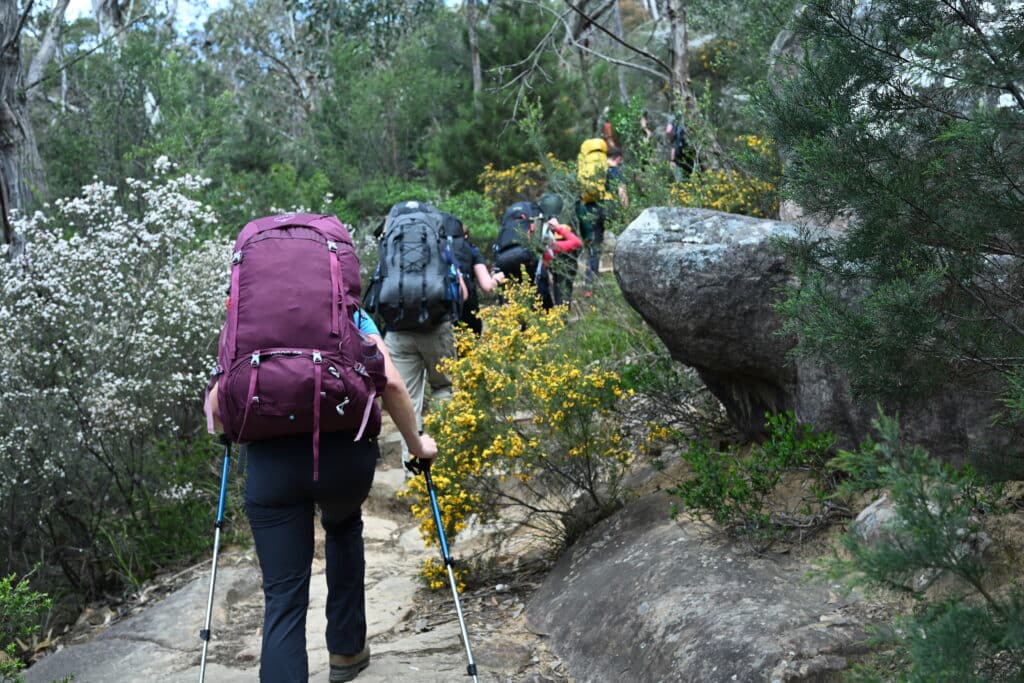
Sometimes it is simply by going for a walk. Being side by side.
As many of you know, Park Trek has traditionally focused on public walks. Increasingly, however, we’re working with private groups, leadership teams, corporate organisations, and charities to create tailored multi-day walking experiences designed around specific objectives, capabilities and outcomes.
For me, one of the most rewarding parts of these experiences is watching teams discover strengths they didn’t know they possessed and relationships they did not realise they needed. The walk itself is often only part of the story. The real value comes from the conversations, the shared challenge, the trust that develops and the collective confidence that emerges when a group achieves something meaningful together.
Let Me Know Your Thoughts
If you’re a leader looking to strengthen your team, build resilience, improve collaboration, or simply create an experience that people will remember long after they return to the office, I’d love to talk with you. Every organisation is different, and every experience can be tailored.
So, if you really want to understand your team, your peers and your own leadership capability, there may be no better place to start than by stepping away from the boardroom, and on to a trail, to see what happens when you tackle a challenge together.
I would love to hear your thoughts.
Who are the people you would want beside you when the pressure is on? How did you come to know they were the right people?

#Leadership #TeamCulture #Connection #Trust #Wellbeing #Walking #Nature #TeamBuilding #LeadershipDevelopment #MentalWellbeing #ParkTrek
Park Trek acknowledges and pays its respects to the Traditional Owners of the lands upon which we wander as a walking company. We recognise the unique place held by Aboriginal and Torres Strait Islander peoples as the original custodians of the lands and waterways across our continent, with histories of continuous connection dating back more than 60,000 years. We are proud to live on the planet’s oldest continent with the oldest continuous living culture. We support the Uluru Statement from the Heart.