The outback (or “near outback” as we affectionately call the Flinders Ranges) asks different things of a walker than the coast or the mountains do. A July morning in the Flinders can start with frost on the ground and finish in shirt-sleeve sunshine. The ground is loose quartzite rather than boardwalk, and the nearest hospital may be many hours away by road.
None of that should put you off. With the right preparation, a guided outback walk is one of the most rewarding things you can do in Australia: ochre ridgelines at sunrise, ancient gorges, cool waterholes and a night sky that most of us have never properly seen.
This guide covers how to prepare specifically for outback walking, from choosing the right walk and month to training, packing, managing heat and cold, camping in a swag, and walking respectfully on Country. If you want the general basics for any multi-day walk, start with our guide on how to prepare for a multi-day guided walk in Australia. This article picks up where that one leaves off.
What makes outback walking different from other Australian walks?
Outback walking differs in many ways. Temperatures can swing dramatically between night and day. The sun can be intense with little shade. Walking surfaces are often rocky and uneven. And because help can be hours away, good safety practices and procedures are key if something does go awry. Fitness matters, but preparation for these unique outback walking conditions is key.
| Factor | Coastal or alpine walks | Outback walks |
|---|---|---|
| Main weather risk | Rain, wind, sudden cold fronts | Heat by day, near-freezing nights |
| Daily temperature range | Usually under 10°C | Often 12°C or more |
| Shade on the trail | Forest and headlands offer cover | Sparse, often none on ridgelines |
| Track surface | Sand, boardwalk, formed track | Loose rock, quartzite, dry creek beds, spinifex |
| Water on the trail | Creeks and tanks are common | Scarce, carried from camp |
| Distance to medical help | Often under an hour | Often several hours |
| Phone coverage | Patchy | Frequently none |
| Main nuisance | Leeches, mosquitoes | Bush flies, dust |
The point of this table is not to alarm you. It is to show why an outback packing list and training plan look different from a Tasmanian one. A waterproof jacket is the most important item on a Cradle Mountain day. In the Flinders Ranges, it is more likely to be your hat, your water capacity and a warm sleeping bag.
Did you know? In Western Australia, up to a quarter of Royal Flying Doctor Service emergency evacuations involve travellers who get into trouble in the outback. Most of those situations come down to underestimating heat, distance or water.
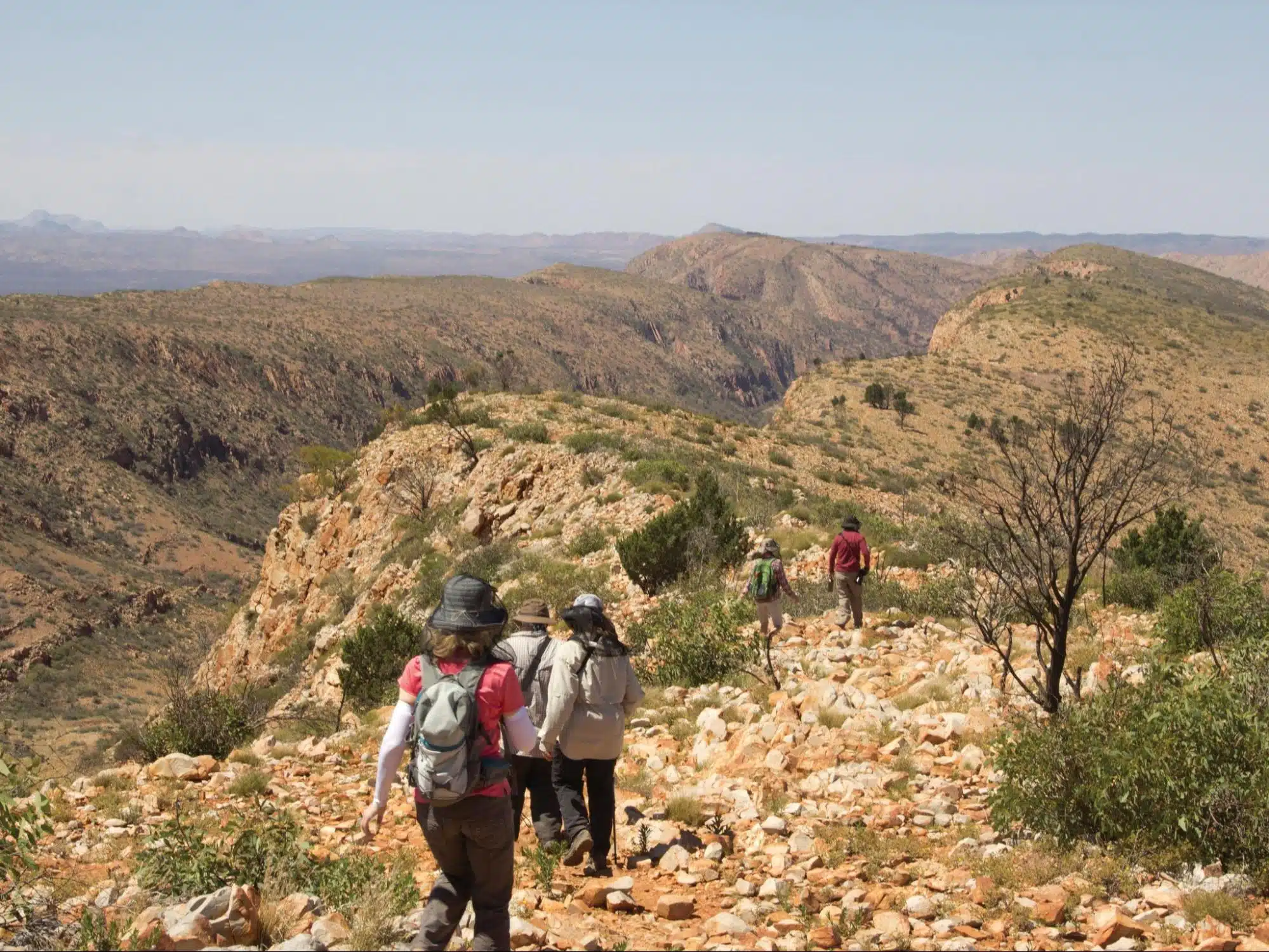
Which guided outback walk suits you?
The right outback walk depends on how many consecutive days you want to walk, whether you would rather sleep in a bed or a swag, and how much elevation you are comfortable with. Park Trek runs outback walks in the Flinders Ranges, including a camel-supported walk, and on the Larapinta Trail in Central Australia, each walked with a daypack only.
| Walk | Days | Distance | Grade | Where you sleep | Best for |
|---|---|---|---|---|---|
| Flinders Ranges (Ikara) Guided Walk | 5 | 40 km | 2-4 | Rawnsley Park Station | A first outback walk with comfortable accommodation |
| Flinders Ranges with Camels | 9 | 100 km | 2-3 | Swags under the stars | Walkers who want a slower pace and true remoteness |
| Ikara-Flinders Ranges, 7 days | 7 | 66 km | 2-5 | Various lodges | Private groups wanting more of the ranges |
| Larapinta Highlights & Mt Sonder | 7 | 65 km | 2-5 | Permanent camp on Arrernte homelands | Fit walkers chasing the Red Centre’s best ridgelines |
Explore each walk in detail: the Flinders Ranges (Ikara) Guided Walk, the Flinders Ranges with Camels, the Ikara-Flinders Ranges, 7 days and the Larapinta Highlights & Mt Sonder.
A quick rule of thumb:
- Never done an outback walk: start with the 5-day Flinders Ranges walk. You get the gorges, the wildlife and the cultural history with a proper bed every night.
- Comfortable with a few hills and keen to camp: the Flinders Ranges with Camels walk sets a gentle Grade 2-3 pace while the camels carry the gear.
- Fit, confident on rough ground and happy with an early start: the Larapinta Highlights walk includes a pre-dawn ascent of Mt Sonder, one of the great sunrises in Australia.
Grades follow the Australian Walking Track Grading System. If you are unsure what a Grade 4 day feels like in practice, read how we grade our walks or take the find your perfect walk quiz.
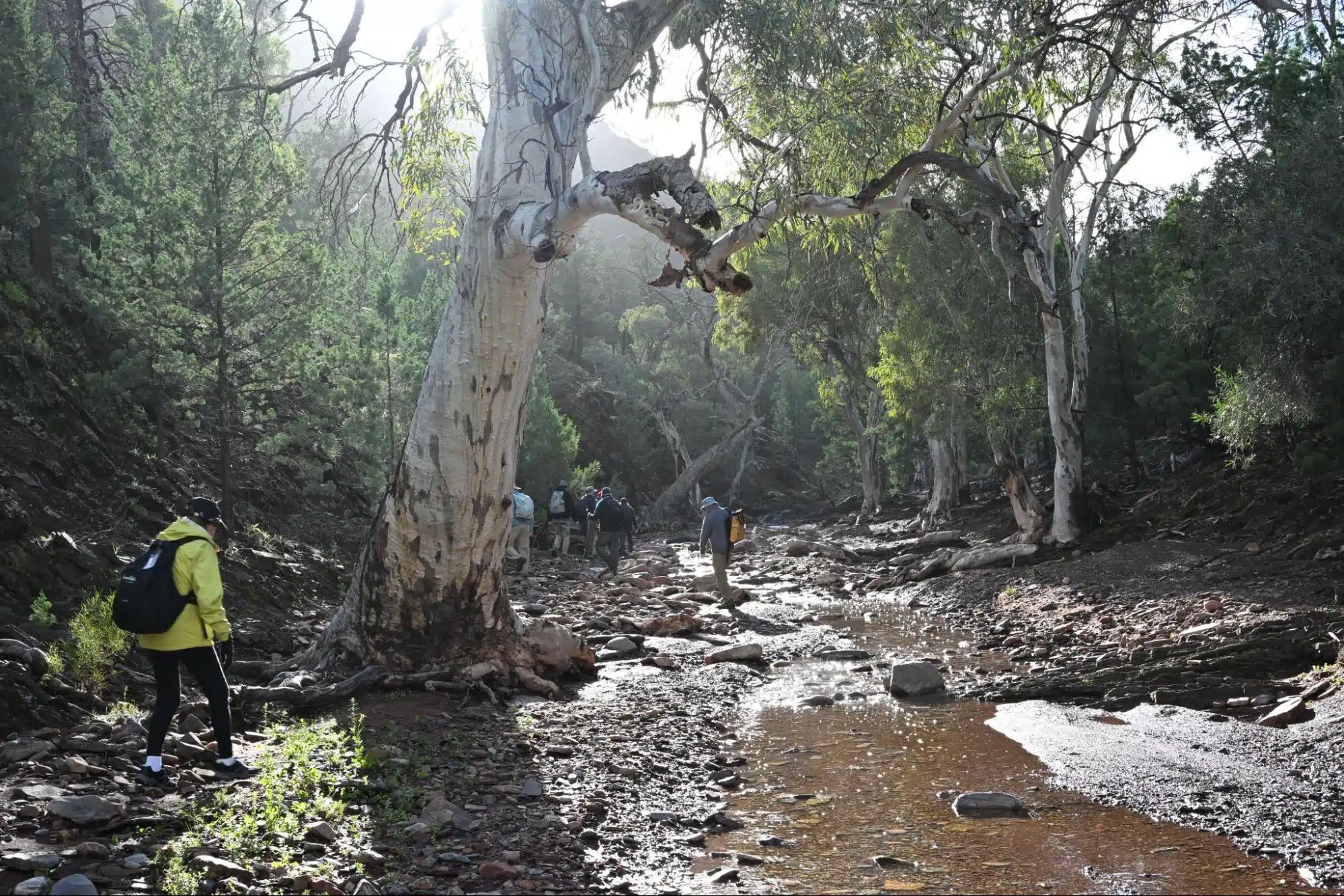
When is the best time to walk in the Australian outback?
The best time to walk in the Australian outback is from April to September, when days are warm rather than hot and nights are cold and clear. Northern Territory Parks and Wildlife only recommends hiking the Larapinta Trail between April and September, and Central Australia experiences extreme heat from November to March.
| Region | Prime walking window | What to expect |
|---|---|---|
| Flinders Ranges, South Australia | May to September | Cool mornings, clear days, wildflowers from late winter |
| Larapinta Trail, Central Australia | April to September | Mild days, cold nights with frequent frosts in mid-winter |
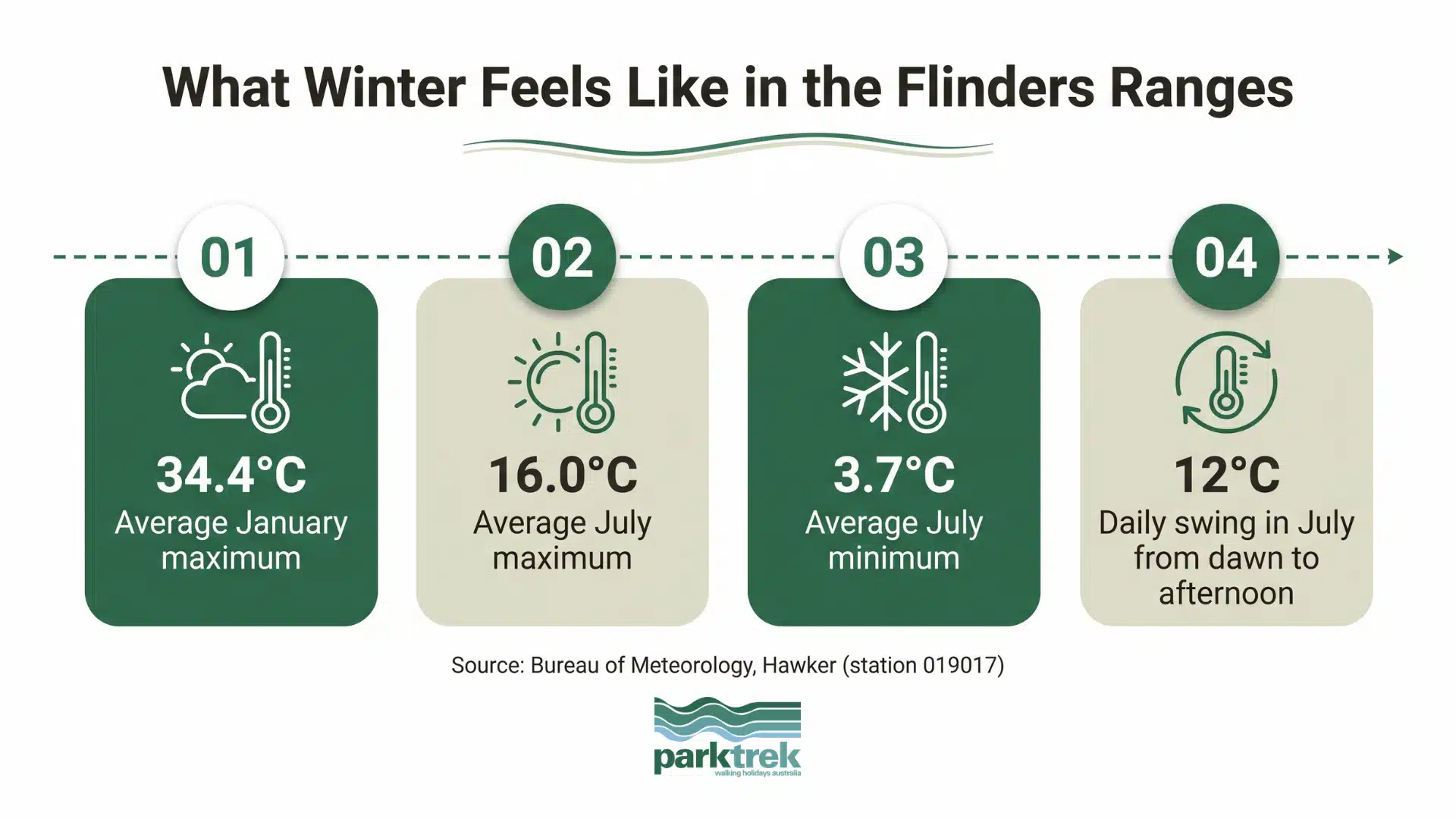
The numbers behind the outback season tell the story. At Hawker, the gateway town to Ikara-Flinders Ranges National Park, the Bureau of Meteorology’s long-term averages show:
- January: mean maximum of 34.4°C
- July: mean maximum of 15.9°C and mean minimum of 3.7°C
- Daily swing in July: around 12°C between dawn and mid-afternoon
That July swing is the single most important fact for your packing list. You will walk in a T-shirt by late morning and need a down jacket by the campfire.
Park Trek times every outback departure for the cooler months, which is why you will not find our Flinders Ranges or Larapinta walks in the summer calendar. In the Flinders Ranges, late winter and early spring are also when the Sturt Desert Pea, South Australia’s floral emblem, begins to flower. Read more about where to see Sturt Desert Pea on our Ikara-Flinders Ranges walk, or check the walking calendar to see how outback season fits around our other destinations.
How fit do you need to be for an outback walking tour?
You need to be able to walk 12 to 16 kilometres over rocky, hilly ground with a light daypack, on consecutive days, and recover overnight. Most reasonably active adults can reach that standard with around twelve weeks of consistent, specific training.
Our walkers are mostly aged between 45 and 75, and many are first-timers. What separates a comfortable outback walk from a hard one is rarely age. It is how well your feet, ankles and knees handle uneven ground, and whether your legs have practised walking two or three days in a row.
Outback terrain has its own demands. On the Flinders Ranges walk, the Heysen Trail day from Black Gap into Wilpena Pound runs 12 to 15 kilometres with a climb up the Pound wall. On the Larapinta Highlights walk our toughest day is the ascent of Mt Sonder, which starts in the dark and covers about 16 kilometres with roughly 780 metres of elevation gain. Dry creek beds, loose scree and quartzite steps are where most walkers feel it.
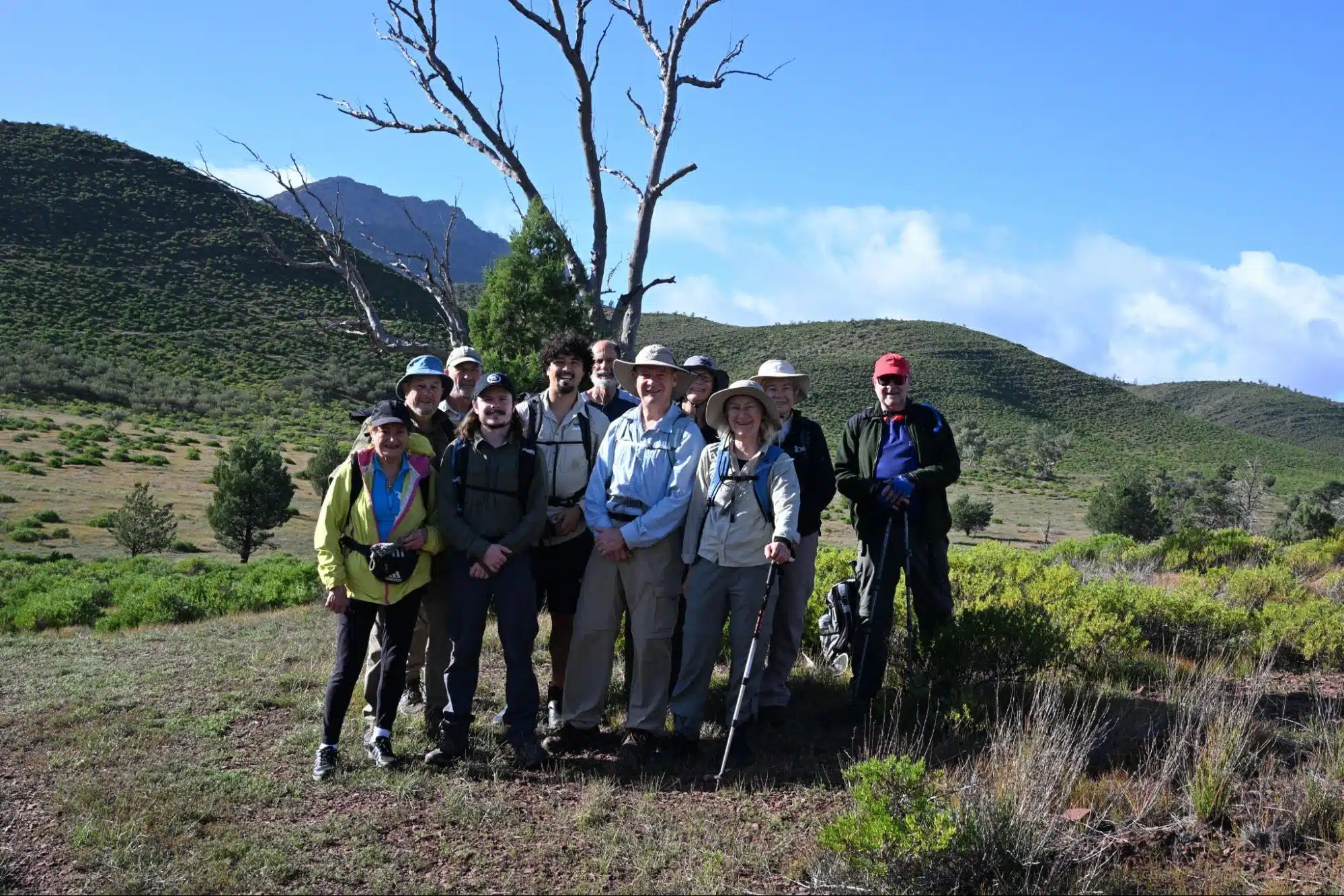
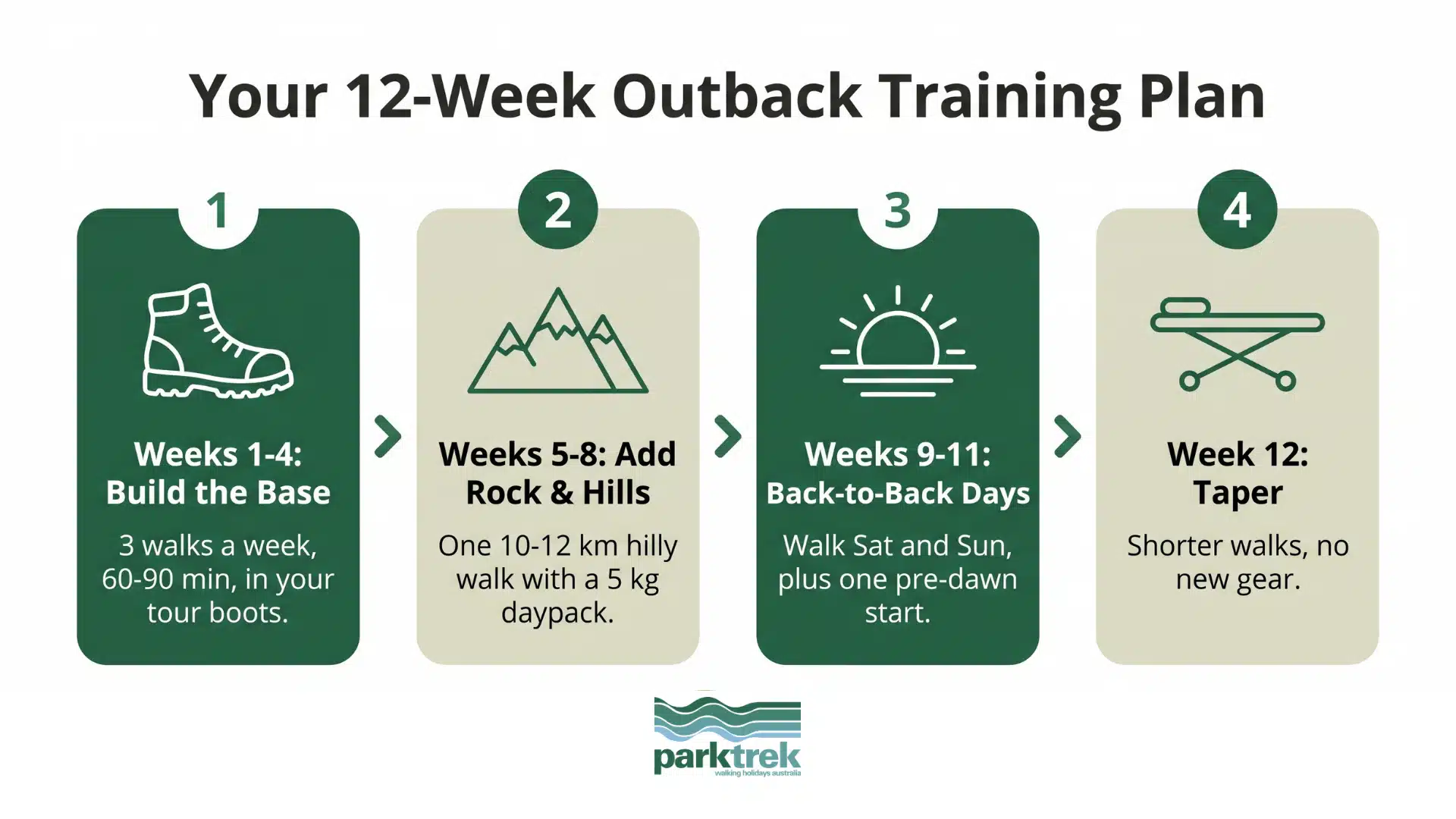
A 12-week outback training plan
1. Weeks 1 to 4: build the base. Walk three times a week for 60 to 90 minutes in the boots you will wear on tour. Include at least one walk on gravel or bush track, not just footpaths.
2. Weeks 5 to 8: add rock and elevation. Make one weekly walk 10 to 12 kilometres with real hills and a daypack loaded to about five kilograms. Seek out rocky, uneven tracks or creek beds, because that is what outback walking feels like underfoot.
3. Weeks 9 to 11: walk back-to-back days. Walk on Saturday, then again on Sunday. Once in this block, start a walk before sunrise with a head torch, to rehearse the early starts that outback guides use to avoid the heat.
4. Week 12: taper. Shorter walks, no new gear, and rest before you fly to the walk.
Two other outback-specific points to build in:
- Train your descents. Coming down loose quartzite or scree is harder on knees than going up. Practise controlled downhill walking and consider whether hiking poles suit you.
- Don’t try to “heat train” in summer. Walking in extreme heat at home carries real risk and does little for a winter outback walk. Train in the cooler parts of the day and focus on terrain instead.
For a full program, see our guide on how to train for a multi-day hike, or check whether you are ready with how to know you’re fit enough for a multi-day hike.
What should you pack for a guided outback walk?
Pack for two climates in one day: sun and dry heat on the trail, and cold, often frosty nights at camp. On a guided walk your main bag is transported for you, so the real job is getting your daypack and your sleeping kit right.
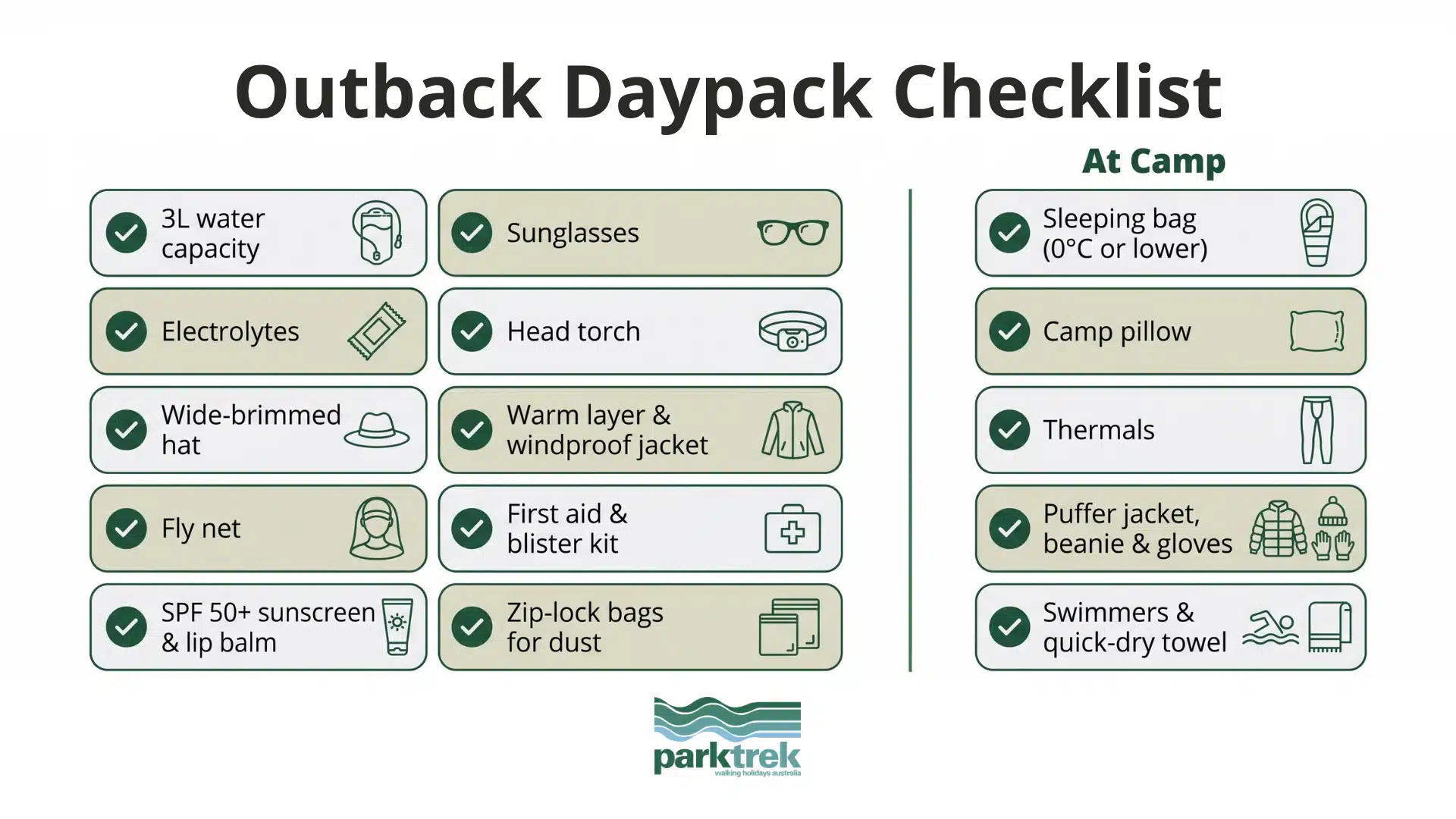
Always check the trip notes for your specific walk, which include the full gear list. The items below are the ones that matter most in outback conditions.
Your daypack on the trail
- Water capacity of at least three litres. A hydration bladder plus a bottle works well. Your guides will confirm how much to carry each day.
- Electrolyte tablets or sachets. Water alone is not enough on a long, warm day (more on this below).
- Wide-brimmed hat. A cap leaves your ears and neck exposed for six hours.
- Fly net. It weighs nothing and can make the difference between a pleasant lunch and a miserable one.
- SPF 50+ sunscreen and SPF lip balm. Reapply every two hours.
- Sunglasses with good UV protection. The glare off pale rock is strong.
- Head torch with fresh batteries, for pre-dawn starts and walking back to your tent.
- Light warm layer and windproof jacket. Ridgelines get windy, and mornings start cold.
- Personal first aid items, any medication, and blister care.
- Small zip-lock bags to keep dust out of your phone and camera.
Clothing for outback days
The goal is to cover up from the sun by day and stay warm at night without carrying a wardrobe.
- Lightweight long-sleeved shirt in a breathable synthetic or merino fabric. Long sleeves protect from sun and scratchy spinifex.
- Walking pants or zip-off pants. Shorts are fine for some, but pants protect your legs on scrubby sections.
- Low gaiters. Light, breathable ankle gaiters keep seeds, grass and gravel out of your boots. Full alpine gaiters are too hot.
- Thermal top and leggings for cold mornings and sleeping.
- Down or synthetic puffer jacket, beanie and gloves for evenings by the fire.
- Swimmers and a quick-dry towel. The Flinders Ranges creek pools and Ormiston Gorge on the Larapinta Trail are some of the best swims in Australia.
Our article on what to wear on a guided walking holiday covers layering in more detail.
Footwear
Wear mid- or high-cut boots with good ankle support and a firm sole. Outback rock is sharp and uneven, and it wears through light trail runners quickly. Whatever you choose, make sure your boots have several long walks behind them before you leave. See boots or shoes: choosing the right hiking footwear.
Your sleeping kit
On the walks where you camp, you bring your own sleeping bag, and it needs to be warm enough for nights that regularly drop to near zero.
- Sleeping bag rated to 0°C or lower. This is the recommendation on the Flinders Ranges with Camels walk, and a sensible minimum for Larapinta in mid-winter.
- Camp pillow. Required on the Larapinta walk and recommended elsewhere.
- Sleeping bag liner (optional) for extra warmth and easier washing.
- Ear plugs and an eye mask if you are a light sleeper.
What you can leave at home
- Tent, stove, cooking gear and food (all provided)
- More than a couple of changes of walking clothes (outback air dries clothing fast)
- Jeans and heavy cotton, which stay damp and cold
- Hair dryers and bulky electronics, as camp power is limited
How much water should you drink on an outback walk?
Plan on roughly one litre of water for every hour of walking in warm conditions, sipped steadily rather than in large amounts at rest stops. Pair that water with electrolytes, because drinking large volumes of plain water without replacing salts can be dangerous in its own right.
Parks Australia’s guidance for Uluṟu-Kata Tjuṯa lists hyponatraemia, a drop in blood sodium, alongside dehydration and heat exhaustion as real risks for walkers in Central Australia. It happens when walkers sweat out salt and replace it only with water. Electrolyte tablets, salty snacks and eating a proper lunch all help.
Practical habits that work:
- Start the day hydrated. Drink a glass or two of water with breakfast, not just coffee.
- Drink before you feel thirsty. In dry outback air, sweat evaporates so quickly you may not notice how much you are losing.
- Check your urine colour. Pale straw is good. Dark yellow means drink more.
- Eat regularly. Snacks and lunch replace salts and keep your energy up on climbs.
- Go easy on alcohol at camp. It dehydrates you for the next morning’s walk.
How do you recognise and avoid heat illness?
Heat exhaustion shows up as heavy sweating, headache, dizziness, nausea and unusual tiredness. Heatstroke is a medical emergency, marked by a body temperature above 39°C, red, hot and dry skin, confusion and a lack of sweating. If you feel unwell on the trail, stop, rest in shade, drink water and tell your guide straight away.
The best defence is timing. Outback guides start early, walk the climbs in the cool of the morning and plan lunch in shade. That rhythm is one of the quiet benefits of walking with a guided group: the day is built around the conditions, so you don’t have to make those calls yourself.
Northern Territory Parks and Wildlife also advises:
- Checking forecast temperatures before every walk and avoiding extreme heat
- Applying SPF 30+ sunscreen 20 minutes before setting out and every two hours after
- Wearing light-coloured, loose and breathable clothing
- Avoiding alcohol and caffeine as your main drinks, as both can worsen dehydration
On a Park Trek walk, your guides adjust walking times and distances to the conditions on the day. On a warm afternoon, that may mean a shorter loop or a longer swim.
How do you deal with flies, sun and dust in the outback?
A fly net, a wide-brimmed hat and a small dust kit solve most of the outback’s everyday irritations. None of them are dangerous, but all three can wear you down over a week if you arrive unprepared.
Bush flies are most active in warmer weather and after rain. They don’t bite, but they are persistent. A head net over your hat is the simplest fix, and personal insect repellent helps. Cooler winter departures usually mean fewer flies.
Sun in the outback is stronger than many visitors expect, even in winter. There is little shade on the ridgelines and the pale rock reflects light upwards. Cover up with long sleeves and a broad hat, and protect the backs of your hands, which are easy to forget.
Dust is fine, red and gets everywhere. A few habits help:
- Keep phones, cameras and spare batteries in zip-lock bags
- Bring glasses as a backup if you wear contact lenses
- Pack a buff or neck gaiter to pull over your nose and mouth on windy days
- Bring moisturiser and saline eye drops, as the dry air is hard on skin and eyes
What is camping on an outback walking tour actually like?
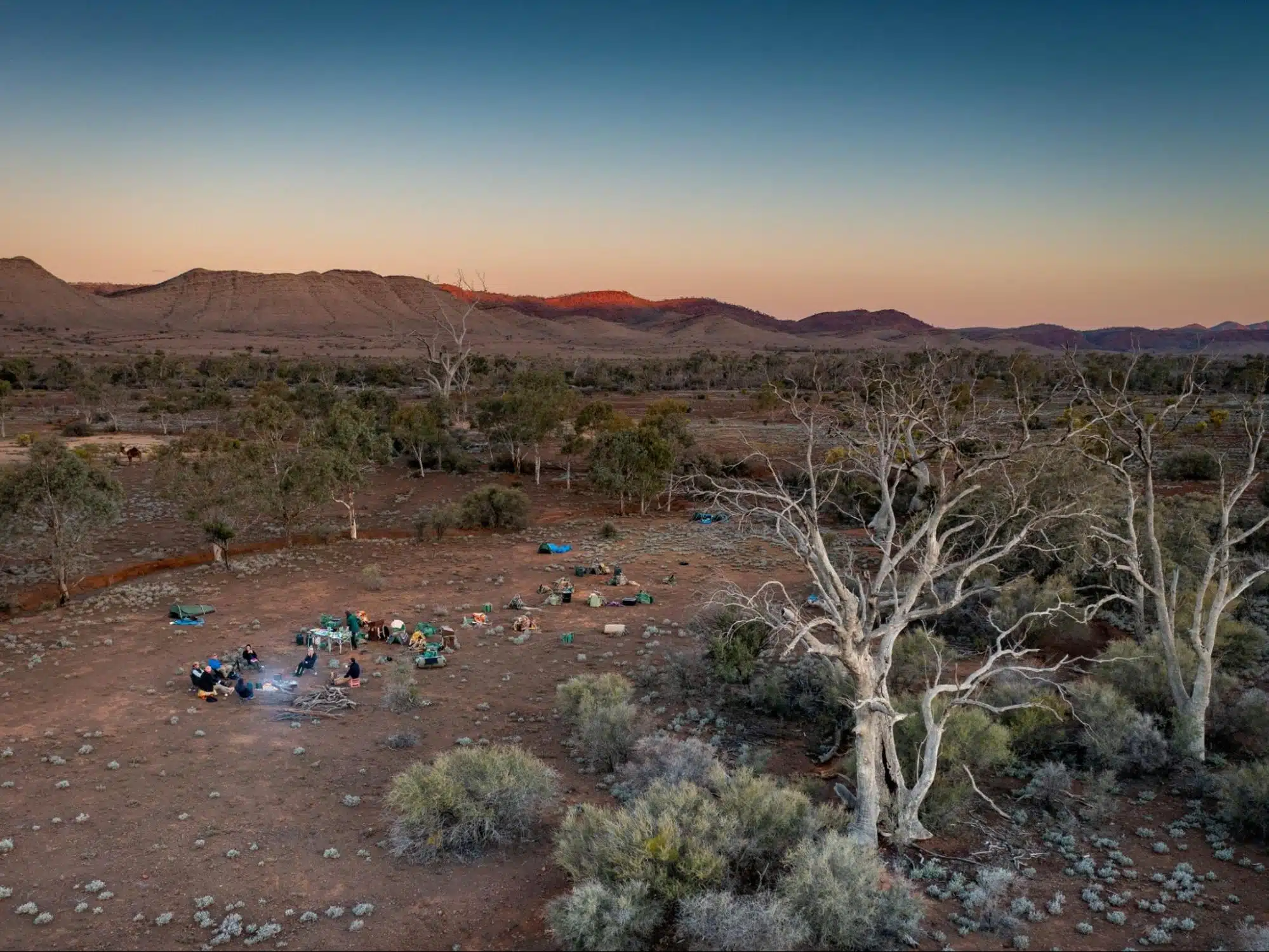
Camping on a guided outback walk means sleeping in a swag or a stand-up tent at a prepared camp, with meals cooked for you and a campfire most nights. You bring your sleeping bag and pillow. The guides and crew handle everything else.
Each Park Trek outback walk has a different style of accommodation, so it is worth knowing what to expect before you pack.
| Walk | Accommodation | Bathrooms | What you bring |
|---|---|---|---|
| Flinders Ranges, 5 days | Rawnsley Park Station, 4 nights | Full facilities | Standard clothing and toiletries |
| Flinders Ranges with Camels, 9 days | Your own swag, camps chosen each afternoon, final night at the Blinman Hotel | No formal bathrooms until the last night | Sleeping bag rated to 0°C, optional pillow and mat |
| Larapinta Highlights & Mt Sonder, 7 days | Private permanent camp on Arrernte homelands, stand-up tents with stretcher and swag, plus 2 nights in Alice Springs | Hot showers and camp toilets | Sleeping bag and camp pillow |
A swag is a canvas bed roll with a built-in mattress. It is warmer and more comfortable than most people expect, and the insect-proof versions keep the night visitors out. Each morning your sleeping bag is rolled inside the swag and loaded onto the vehicle or, on the camels walk, onto the camels.
A few tips for your first nights out:
- Wear your thermals and beanie to bed on cold nights. Most heat is lost through your head.
- Keep your head torch, water and warm layer within reach before you settle in.
- Bring biodegradable wet wipes on the camels walk, and remember that anything you use must be carried out.
- Look up. With no light pollution, the Milky Way is bright enough to cast a shadow on a moonless night.
How do you prepare to walk respectfully on Country?
Prepare by learning a little about the Traditional Owners of the land you will walk on, and by following your guides’ advice on where you can go, what you can photograph and which stories can be shared. Outback walks pass through some of the most culturally significant landscapes in Australia, and many have living ceremonial meaning today.
In the Flinders Ranges, Country belongs to the Adnyamathanha people, and our walks include time with an Adnyamathanha guide sharing knowledge of bush tucker, bush medicine and the ancient engravings at Dingley Dell. On the Larapinta Highlights walk, you camp on Arrernte homelands and walk with local Aboriginal guides, who share stories connected to places such as the Ochre Pits and Mt Sonder (Rutjupma).
Simple ways to walk respectfully:
- Learn a few place names in the local language before you go. Ikara is Wilpena Pound. Tjoritja is the West MacDonnell Ranges. Mparntwe is Alice Springs.
- Ask before you photograph people, rock art or ceremonial sites, and respect signs that restrict photography.
- Follow guidance on gendered sites. Standley Chasm, for example, is a sacred women’s site.
- Leave everything as you found it. Rocks, ochre and plants stay where they are.
- Listen more than you ask. Some stories are not for sharing, and a good guide will tell you which.
This cultural layer is one of the strongest reasons to walk the outback with a guide. You don’t just see the landscape. You start to understand it.
How should you plan flights, arrival and insurance?
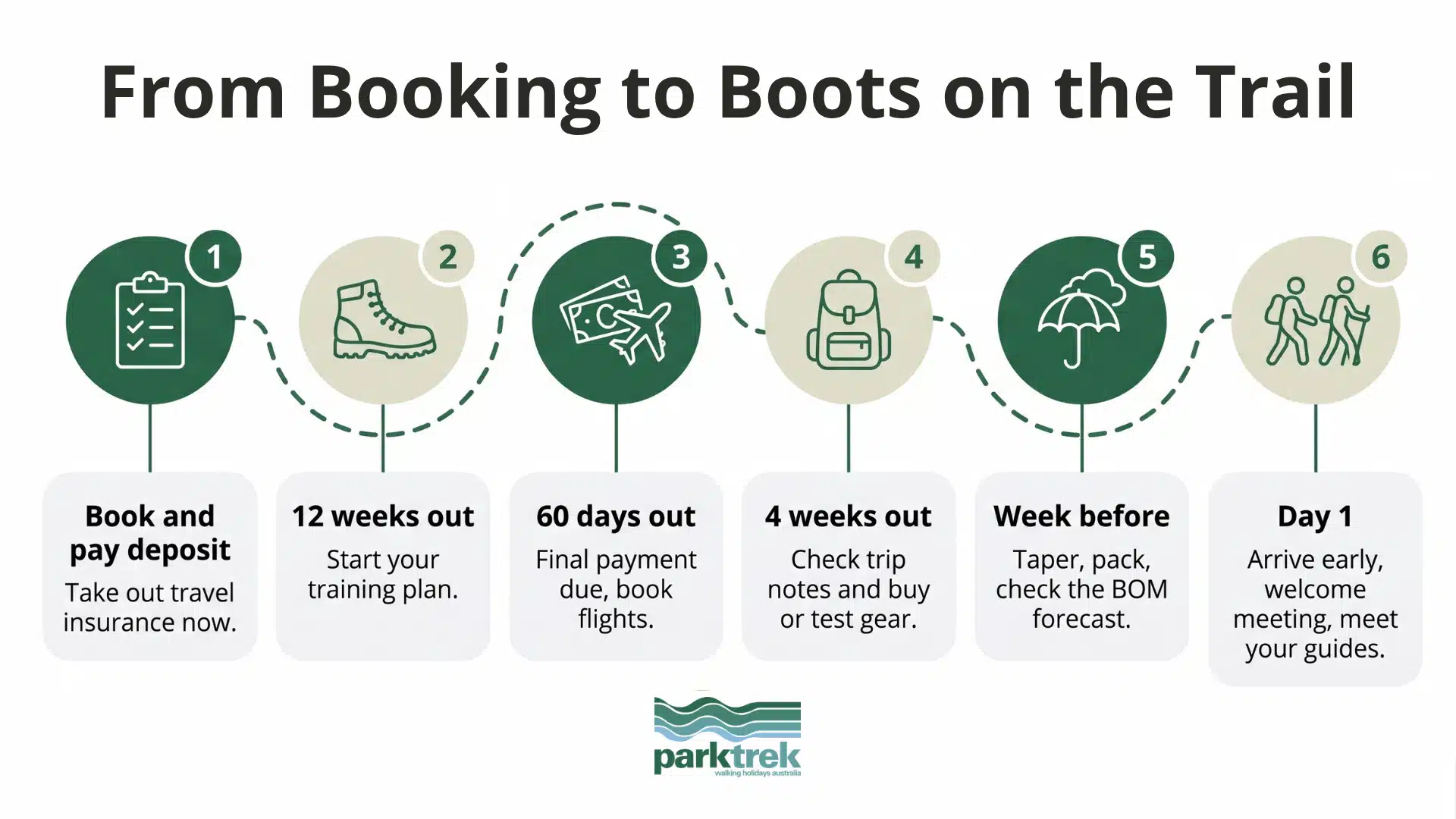
Book flights that land you comfortably before the welcome meeting and leave after the tour returns, and buy travel insurance that includes emergency evacuation as soon as you pay your deposit. Outback tours start in regional hubs with limited flights, so the logistics deserve more attention than a city-based walk.
Getting there
Flinders Ranges walks: departures leave Adelaide early in the morning (7:15am for a 7:30am departure on the 5-day walk). Book a hotel in Adelaide the night before. Flights home should leave after 7pm on the final day.
Larapinta Highlights: fly into Alice Springs, ideally arriving by 4pm on Day 1. The welcome meeting is at 6pm in the hotel lobby, and it is where your guides collect insurance and emergency contact details. Accommodation is included on Day 1 and Day 6, and Day 7 is free before your flight out.
Insurance and paperwork
Park Trek strongly recommends travel insurance from the moment you pay your deposit. For outback walking, check that your policy covers:
- Medical expenses and personal accident
- Emergency evacuation and repatriation from remote areas
- Cancellation for illness, bereavement or force majeure
- Delayed flights and lost luggage
Complete your booking form in full, including medical conditions, medications and dietary needs. On a remote walk, your guides are your first responders, and they need that information before Day 1.
Phone coverage
Expect little or no mobile coverage once you leave town. Telstra generally offers the best reception in remote areas, but even that is patchy on the trail. Let family know your itinerary before you leave and give them the Park Trek office number, 1300 775 875, for emergencies. Your guides carry communications and safety equipment.
Guided or self-guided: which is better for the outback?
For most walkers, a guided walk is the safer and more rewarding way to experience the outback for the first time. You’ll have an experienced guide to care for you and inform you about the local flora, fauna and landscape.
In contrast, self-guided outback walking demands that you properly consider water planning, navigation, heat judgement, and self-rescue skills, among other things, in country where help can be hours away. All of this is summarised in our table below.
| Consideration | Self-guided | Guided pack-free with Park Trek |
|---|---|---|
| Pack weight | 15-20 kg, including water | Daypack only |
| Water | You plan tank refills and food drops | Carried and managed by the crew |
| Navigation | Your responsibility, often with maps and GPS | Experienced, accredited guides |
| Heat and weather decisions | Your call | Guides adjust times and routes on the day |
| Accommodation | Basic campsites, tent carried | Station stay, swags or permanent camp |
| Meals | Carried and cooked by you | All main meals, snacks and drinks provided |
| Cultural interpretation | Interpretive signs | Local and Aboriginal guides |
| National park fees | You arrange | Included |
| Best for | Experienced desert walkers | First-timers, solo travellers, anyone short on planning time |
The difference shows most clearly on a hard day. A self-guided pair on a hot afternoon has to decide alone whether to push on. A guided group simply adjusts, because the guides know the country, carry safety gear and have a vehicle waiting. Read more about why professional guides make such a difference and what is included on every Park Trek walk.
Your outback pre-departure checklist
Before you leave home, run through this list:
1. Confirm your walk’s grade and daily distances against your training
2. Read your trip notes and gear list in full
3. Buy or borrow a sleeping bag rated to 0°C or lower if you are camping
4. Wear in your boots over at least three long walks
5. Pack a fly net, wide-brimmed hat, electrolytes and a head torch
6. Take out travel insurance that covers remote evacuation
7. Complete your booking form with medical and dietary details
8. Book flights that suit the start and finish times
9. Check the Bureau of Meteorology forecast for your region in the final week
10. Leave your itinerary and the Park Trek office number with someone at home
Frequently asked questions
Ready to walk the outback?
The outback rewards walkers who arrive prepared. Get the season right, train on rocky ground, pack for both heat and frost, and let experienced guides handle the water, the route and the timing. What is left is the walking itself: ancient ranges, quiet gorges and evenings by the fire under the clearest sky in the country.
Park Trek has been guiding small-group, pack-free walking holidays across Australia for more than 25 years. Every outback walk includes accommodation, meals, transfers, national park fees and experienced local guides, with a daypack the only thing you carry.
- Explore our South Australia walks, including the Flinders Ranges with and without camels
- Discover our Northern Territory walks, including Larapinta Highlights & Mt Sonder
- Check departures by month to plan around winter
- Early Explorers save $300 when booking 6+ months ahead, and private groups of 8+ save up to 10 per cent (offers exclude the Flinders Ranges with Camels and Larapinta walks)
- Talk to our team on 1300 775 875 about which outback walk suits you
Park Trek acknowledges the Adnyamathanha, Arrernte and all Aboriginal peoples as the Traditional Custodians of the lands on which we walk, and pays respect to Elders past, present and emerging.